Dear readers,
As indicated in the previous newsletter we are preparing an academic paper on a potential alternative for central banks being a liquidity provider in times of crises and acting as the lender-of-last-resort. As you all know this is closely related to the moral hazard and too-big-to-fail issues.
Recent events have once again shown we are unfolding an endgame where socializing losses cannot continue at the current pace. Instead of a too-big-to-fail risk we are now entering into a dangerous zone of too-big-to-rescue.
In this weeks’ newsletter will show why we have reached this turning point with illustrated data on accumulated outstanding guarantees governments are taking onto their balance sheet. As an example we would take the EUR-zone country Belgium, which has recently come into the spotlight of financial markets due to the forced bailout of one of its banks. The author would like to stress that this is not an isolated case and that a similar exercise is trivial for other EUR-zone member states.
In case of the Kingdom of Belgium the current total public debt as a percentage of GDP is around 98%. Like many other governments this percentage rose quickly at the end of 2008 during the first Great Credit Crisis, in an attempt to save its banking industry.
As a reminder we sum up the amounts that were in large responsible for this rise of debt:
• 29 September 2008: Fortis Bank NV/SA a EUR 4.7 billion cash injection by the Federal Government of Belgium in exchange of 50%+1 shares in common equity of which 75% of shares were transferred to BNP Paribas. In exchange the Belgian Government became a 11.6% shareholder of the French bank. (bear in mind that at the moment of conversion the BNP Paribas share price was still well above EUR 60 per share compared to a share price of EUR 26.85 today)
• 30 September 2008: Dexia Bank NV/SA a EUR 1 billion cash injection of the Belgian Government next to another EUR 1 billion investment by the 3 regional governments of the country.
• 8 October 2011: Dexia Bank NV/SA is bailed out by France and Belgium, of which the Belgian government will pay EUR 4 billion for the Belgian franchise.
• 20 October 2008: Ethias received a EUR 1.5 billion cash injection by the 3 regional governments of the country.
• 27 October 2008: KBC Bank NV receives a EUR 3.5 billion direct investment by the Federal Government, where the proceeds are used to strengthen its Tier 1 capital by EUR 2.5 billion plus a solvency margin on its insurance business by EUR 1 billion. This operation is completed on the 19th of December 2009 by issuing non-transferable, non-voting core capital securities to the Belgian government at EUR 29.5 per share (current share price is EUR 9.5 per share). Then, the Flemish Government supported on aggregate another capital injection of EUR 3.5 billion between January 2009 and May 2009 based upon similar terms and conditions as the Belgian Government.
• On a side note, car manufacturers Ford Genk and Volvo Ghent received subsidies and tax relieves of respective EUR 9.3 million and EUR 300 million.
Unfortunately the rescuing of the banking industry did not stop with direct capital injections. Additional government guarantees had to be put in place for outstanding liabilities. The latter is becoming a hazardous situation for public finances in general.
As Belgium is concerned the following guarantees have been underwritten by the government:
KBC Bank: EUR 20 billion of which EUR 5.5 billion of super senior CDO risk and EUR 14.4 billion of counterparty risk on the mono-liner MBIA which wrote credit protection on the banks structured credit portfolio. 90% of default risk is guaranteed by the Belgian government with a 1st loss of EUR 3.2 billion.
Dexia Bank: during the first bailout in 2008 an aggregate of EUR 150 billion of guarantees were granted to the bank by France, Luxemburg and Belgium. These were up to EUR 90 billion re-written during the nationalization of the bank in October 2011, where the Belgian government takes up to 60.5% or EUR 54 billion of guarantees with a maturity of up to 10 years. Next to this guarantee the government inherits, as it is from now on the owner of Dexia Belgium, an un-collateralized credit line of EUR 20 billion to Dexia France. Apart from this credit facility it also inherited a sovereign bond portfolio of EUR 20 of which EUR 8.5 billion has exposure on Greece, Portugal, Italy, Spain and Ireland.
FSA (Financial Securities Assurance Inc.) a US daughter of Dexia NV/SA: USD 16 billion is jointly guaranteed by the French and Belgian government if losses exceed USD 4.5 billion.
Fortis NV/SA: EUR 150 million is guaranteed by the government for interbank transactions. Then a larger guarantee of EUR 5.365 billion is granted for a SPV that is set up to isolate toxic assets of Fortis.
Gemeentelijke Holding ( a cooperative structure of Belgian local authorities: among the regional and federal governments a guarantee of EUR 1.5 billion had to be granted to cover a loan of the Holding to finance a participation for a capital increase in Dexia Bank.
Arco (a Belgian cooperation linked to the Christian Workers’ Union). Via the deposit guarantee system a guarantee has been granted for up to EUR 1.5 billion to cover losses on Dexia shares.
NMBS Holding (Belgian Rail Road) A Belgian government guarantee to cover 80% of a sale and lease back operation with AIG. Guarantee in EUR equals EUR 260 mio.
Then we do not take into account pension liabilities that have been taken over by the Belgian government, such as the Belgacom Pension fund for a minimum liability of EUR 5.8 billion, pension fund of the Port Authorities of Antwerp etc. The fee the government received in exchange of taking over the liabilities was deposited into a so called Silver fund which invested in EUR sovereign bonds such as Germany, France but also Italy, Greece etc…..
The above list already accounts for over EUR 140 billion of guarantees. The entire amount is not at risk. However, taken into account that a lot of these guarantees are related to sovereign and toxic paper that is facing haircuts of 50% and even more (Greece will eventually be faced with haircuts of up to 80-90% and the same can be argued for toxic assets in the portfolio of Fortis, KBC and Dexia), it is not unrealistic to assume that the outstanding public debt as a percentage of GDP can rapidly rise to levels far above 120%.
These are levels well above those like Portugal, and close to those of Italy, both countries that are already spit out by the bond market. Considering these levels, the government is hardly capable of executing its moral hazard role it has been playing over the last couple of years. This means that if one of their last standing banks, that is KBC, would need to ask for additional government support, the Belgian government would get stuck between a rock and a hard plate.
If it would be forced into a situation where it has to rescue the bank, the public debt would shoot well above the levels of Italy as it would have to take on additional guarantees such as an impaired Irish loan portfolio of EUR 18 billion, which the bank is carrying.
If on the other hand the government argues the bank is too-big-to-rescue, it would trigger a run on the Belgian banking system as we have seen in Iceland back in 2008, and as a result the Belgian government would see its liabilities sky rocket as well due to the deposit guarantee system that it is responsible for.
In both cases an eminent bankruptcy is around the corner and the country would need to ask for direct support from the ECB, which is more and more hesitant to step in, as we have seen in its recent market operations.
As we mentioned earlier on, the above described scenario can be applied on other countries such as Ireland, Portugal, Italy and even France. Between now and 2014 the EUR zone would need a sovereign refinancing together with a banking recapitalisation of close to EUR 4 trillion.
These are numbers that sends chills through your spine and show that Europe or more in general the world is in a structural state of balance sheet depression. Inspired by the work of Reinhart & Rogoff, the BIS recently published a report on "The Real Effects of Debt". (1)Its conclusion is that the deleveraging process will continue most of this decade. Taking the above mentioned numbers into account, we certainly are not going to challenge this.
Nevertheless this brings us to the one million dollar question which has kept us awake over the last 3 years: will it either be deflation or inflation that the world economy will be facing?
The answer is not straight forward. Most probably the outcome will be similar to what the EUR-zone has been coping with over the last decade. Certain regions will be struggling with deflationary price pressures. Other regions will see (considerable) upward price pressures.
As for Europe is concerned we share the view of analyst Simon Hunt.(2) Germany and the ECB will have to decide whether they want to safe the EUR project or allow it to explode with a big bang. Either they agree upon the ECB, probably in cooperation with the EFSF, to open up the printing machine where even Ben Bernanke would start feeling uncomfortable with. However, the chance that this decision will be vetoed by either the old Bundesbank lobby or the German’s Constitutional Court is immense high. Nevertheless, this would further destabilize the system and trigger acceleration in asset inflation.
If they decide not to walk down that road, they will be forced to throw in the towel and accept the fact that the EUR project has failed in its current form. This conclusion will cause even more chaos as this would push the European economy into a deep recession, not to use the word of depression, as all member states will have to introduce their own currencies again. This will put in motion a severe deleveraging process that would deflate all asset prices.
As both scenarios could come straight out of a horror movie it is up to our European and global leaders to start thinking out of the box and start working on a new monetary order as we are in the final stages of the End Game.
[1] Cecchetti, Mohanty, Zampolli "The Real Effects of Debt", Bank of International Settlements, September 2011
[2] John Maulding, Outside the Box, 21st November 2011
Wednesday, 23 November 2011


Sunday, 13 November 2011
A call for structural changes
Remember the Green Shoots back in 2009. It became such an hype that it got rewarded by becoming an official term on Wikipedia. Back then we were highly sceptical and with great disbelieve we saw the market taking off after that memorable G20 summit at the beginning of April which set the streets of London literally on fire.
This encouraged us to participate in the academic debate on causes of the crisis and the challenges we would face in the foreseeable future. All our findings were bundled in a book “The Future of Finance: a New Model For Banking and Investment.”
In brief we warned that nothing was done about the real issues, such as the systemic risk in the financial industry via its exposure on derivatives, the destabilising forces of central banks and governments, and last but not least the colossal debt built up both at the private and public side. All this would trigger a currency crisis which in the end would result in a global sovereign crisis. Hence, investment portfolios should have been protected against this by avoiding certain currency zones and sovereign creditors (cfr. The Rings of Fire) and searching for hard underlying assets.[1]
However, like so many out-of-the-box thinking economists, we were spit out by the system as being too cynical, doom-and-gloom and in the end we ended up shouting in the desert.
The last few months have been particularly interesting. From our desert we have seen the clouds packing together again and noticed a perfect storm is in the making: a sovereign crisis going hand in hand with a banking and currency crisis.
The interesting part is not because we warned for all this back in 2009, but due to the same indecisive approach and ostrich behaviour by our political leaders who still don’t seem to realize that the can they have been kicking down the road is about to hit a brick wall.
In this respect it would be worthwhile to update some of the data we referred to back in 2009-2010 and point at the mounting challenges we are facing.
One of the eye catching data back then was the total global outstanding derivative exposure. After reaching a peak of approximately $ 683 trillion mid 2008 the Great Credit Crisis caused a significant reduction in volume due to the deleveraging that was triggered through the market, however since 2010 volumes picked up again. At the end of June 2010 the exposure was around $ 583 trillion to rise further to $601 trillion by the end of December 2010 (see also most recent data of Bank of International Settlements (BIS))(cfr. Table 3.).
To give the reader an idea of the systemic risk, within the US banking system only 96% of the US outstanding derivative exposure is in the hands of only 5 US banks: JP Morgan, Citi, Bank of America, Goldman Sachs and HSBC Bank USA National Association.
Table 1: Derivative exposure by US commercial banks

Source: Office of the Currency Controller, 2011
The argument that these data are gross numbers, not taking into account the bilateral netting effect among banks and as a result are not representative to outline the risk, does not stand. The issue here is that bilateral netting assumes that in an orderly credit event the issuing bank will honour all its outstanding contracts. Back in 2008 with AIG the market was already confronted with this problem and trillions of dollars threatened to become worthless within a few hours, as those who had bought protection from AIG were at risk to be left empty handed, as Goldman was the only player that was hedged by buying protection on AIG itself.
Until today nothing has done about this issue either. On the contrary it hangs over the market as a very dark cloud. This risk is eminent as European, and among them especially French, banks are in the eye of the storm of the recent European sovereign crisis.
This brings us to our second issue: a perverse and vicious mechanism between a European banking sector which is in principle bankrupt and Euro sovereigns that face the same problem. Deteriorating mark-to-markets of Euro sovereign bonds is pushing banks deeper into insolvency.
Two of our favourite analysts, John Mauldin and Michael Lewitt, point at a too-big-to-rescue issue where European banks hold as much as $55 trillion of assets. This is four times larger than the U.S. banking sector as European banks surprisingly are more leveraged. Until now nothing has been learned from the past on how to fund this enormous position. Back then we made suggestions on proper ALM management that banks should take into account. The major principle in all this is becoming less dependent on wholesale or interbank funding. This has been further worked out more in detail by my co-author, Prof. Dr. Moorad Choudhry, in his recent book “The Principles of Banking” . [2]
Unfortunately European banks are still funding themselves for a large part via the interbank market, which is less stable than deposit money. From this $ 55 trillion almost $30 trillion has to be raised by European banks in the interbank market. Bear in mind this is roughly 10 times more than U.S. banks. As we have seen over the last several weeks, this market dried up completely for European banks, which forces them to pay back this wholesale funding by internal generated cash flows.
Michael Lewitt argues further that this wholesale funding has on average a three year maturity. This means that European banks need to generate approximately $830 billion each month to fund maturing wholesale money. It goes without saying this is not a situation that can take too long which is also indicated by the markets. The CDS market for European banks for example is back at or above the peak levels seen during the 2008 financial crisis. [3]
We could very quickly come into a situation where many other banks face a similar future as Dexia, i.e. nationalization. The problem however here is that governments’ balance sheets are stretched as well. This brings us to our last item of data to be updated, that is total outstanding debt of nations. Remember back then we referred to the famous Rings of Fire of Bill Gross of Pimco.
A similar exercise has recently been done by BIS and they came up with the following numbers:
Table 2: Total debt as a % of GDP

Source: BIS
Compared to the exercise Pimco did back in January 2010 there is a striking difference that much more countries are clustering together in a dangerous debt zone of + 330% of GDP. The only similar conclusion compared to back then is that Japan is still like a bug looking for a windscreen.
Levels like these are unsustainable not only because, as Reinhart and Rogoff concluded, for each 90% of debt in terms of GDP one full percentage of GDP growth is lost. Then we are challenged with the ageing of society which is going to put further pressure on both pension fund managers, who will not be able to realize the over ambitious returns their models are counting on, and public finances of our economies.
To solve this more drastic and structural changes will be necessary. It goes beyond doubt this will take political courage and leadership to say that we all have to make sacrifices and most probably have to take a step back from our current living standards.
My co-author, Prof. Dr. M. Choudhry, and I are preparing an academic paper which will focus on these structural changes we need to push through in the very near future and we will keep you updated on this via our Givanomics newsletters.
To give you a brief indication into which direction we are looking for, we argue that it will be as drastic as the events like Breton Woods (1944), the end of it in 1971 and the Plaza Accords (1985).
It will question our current capitalistic free market model where banks and central banks are the corner stones of the model. In the financial system as we know it we aim for stability. Central banks play a pivotal role in all this to guarantee this stability. In a stable environment liquidity is not an issue and central banks are not on the radar screen. Only in times of shocks one is challenged. The problem however is, there are different kinds of shocks. The question is when or where do we draw the line to step in and guarantee stability again. This is once again the moral hazard issue.
There are shocks of technical nature (such as the potential Y2K event 11 years ago) or geo-political nature (events such as 9/11) or international nature (retreatment of international capital flows such as the Asian and Russian crisis) and corporate nature (such as LTCM, Bear Stearn and Lehman).
We think there is a broad consensus that in principle in case of a corporate shock, we should not use tax payers’ money, as we should not throw good money after reckless behaviour. Unfortunately we let it come way too far as this is an impossible task nowadays due to the interconnectivity of our financial system. We do believe though a great opportunity was missed back in 1998 with LTCM not to do anything about it.
The Fed should not have come to the rescue and should have given an example that a liquidity shock, due to a corporate event, would be something a central bank should step in for. Or, after the rescue of the banks from LTCM one should have done something about the systemic risk in the market, which only grew exponentially since then. Table 3 gives a very good indication on this subject in respect to the rise of derivatives over the last 13 years. The question will be though where to draw the line? Do we only exclude a corporate shock, or even at an international level, such as the examples of Russia, Asia and now Greece etc….?
Table 3: Rise of Derivatives

Source: BIS
Then we also come to our paradox, as in our aiming for financial stability we created central banks. Remember that back in 1907 the US went through a similar deep recession and after the collapse of the Knickerbocker Trust Company, liquidity dried up and there was a run on the banks. It was the late J.P. Morgan himself who put his own private money and that of other fellow competitor bankers on the table to guarantee liquidity and avoid a further collapse of the system. This because of the simple reason, there were no central banks. It was due to this event that two years afterwards the Federal Reserve was founded.
However due to the creation of this type of institution, in order to safeguard financial stability, one put in place public financial safety nets, which are an incentive to moral hazard behaviour, which on its turn is just the very reason why financial instability is created. This is quite of a paradox.
Maybe we should go back to a system as in 1907, where banks had to put a pool of money together themselves to rescue each other. By doing this, you automatically take away the public floor or safety net from underneath the market. From the moment that banks have skin in the game, they probably will be more cautious towards each other when it comes down to wholesale funding and leverage, which were/are one of the major reasons why a liquidity crunch takes place when we are talking about a shock of corporate nature. In case something would go wrong and a bank has to turn to this facility pool, there would be a penalty involved where the bank is absorbed by the others.
This will not be the only challenge. As back in 1944 when Breton Woods was negotiated, we urgently need a new monetary order which would issue new rules on how we deal with global financial and commercial relations and the currency risk that is closely related to this. A question we will ask ourselves is whether abandoning the fiat currency system, which was introduced at the Plaza Accord in 1985, would reduce the leverage in the system.
These are according to us the topics that should come on top of the agenda of G20 summits. Unfortunately these discussions are being avoided and it is far more popular to pin point on a round of bankers bashing or focussing on marginal discussions like abandoning short selling. The longer this discussion is postponed the deeper the crisis will become. We can only hope one does not make the same mistake as President Hoover and his generation did back in the 1930s, which made the crisis even worse. We all know by now what price we had to pay for that.
This encouraged us to participate in the academic debate on causes of the crisis and the challenges we would face in the foreseeable future. All our findings were bundled in a book “The Future of Finance: a New Model For Banking and Investment.”
In brief we warned that nothing was done about the real issues, such as the systemic risk in the financial industry via its exposure on derivatives, the destabilising forces of central banks and governments, and last but not least the colossal debt built up both at the private and public side. All this would trigger a currency crisis which in the end would result in a global sovereign crisis. Hence, investment portfolios should have been protected against this by avoiding certain currency zones and sovereign creditors (cfr. The Rings of Fire) and searching for hard underlying assets.[1]
However, like so many out-of-the-box thinking economists, we were spit out by the system as being too cynical, doom-and-gloom and in the end we ended up shouting in the desert.
The last few months have been particularly interesting. From our desert we have seen the clouds packing together again and noticed a perfect storm is in the making: a sovereign crisis going hand in hand with a banking and currency crisis.
The interesting part is not because we warned for all this back in 2009, but due to the same indecisive approach and ostrich behaviour by our political leaders who still don’t seem to realize that the can they have been kicking down the road is about to hit a brick wall.
In this respect it would be worthwhile to update some of the data we referred to back in 2009-2010 and point at the mounting challenges we are facing.
One of the eye catching data back then was the total global outstanding derivative exposure. After reaching a peak of approximately $ 683 trillion mid 2008 the Great Credit Crisis caused a significant reduction in volume due to the deleveraging that was triggered through the market, however since 2010 volumes picked up again. At the end of June 2010 the exposure was around $ 583 trillion to rise further to $601 trillion by the end of December 2010 (see also most recent data of Bank of International Settlements (BIS))(cfr. Table 3.).
To give the reader an idea of the systemic risk, within the US banking system only 96% of the US outstanding derivative exposure is in the hands of only 5 US banks: JP Morgan, Citi, Bank of America, Goldman Sachs and HSBC Bank USA National Association.
Table 1: Derivative exposure by US commercial banks

Source: Office of the Currency Controller, 2011
The argument that these data are gross numbers, not taking into account the bilateral netting effect among banks and as a result are not representative to outline the risk, does not stand. The issue here is that bilateral netting assumes that in an orderly credit event the issuing bank will honour all its outstanding contracts. Back in 2008 with AIG the market was already confronted with this problem and trillions of dollars threatened to become worthless within a few hours, as those who had bought protection from AIG were at risk to be left empty handed, as Goldman was the only player that was hedged by buying protection on AIG itself.
Until today nothing has done about this issue either. On the contrary it hangs over the market as a very dark cloud. This risk is eminent as European, and among them especially French, banks are in the eye of the storm of the recent European sovereign crisis.
This brings us to our second issue: a perverse and vicious mechanism between a European banking sector which is in principle bankrupt and Euro sovereigns that face the same problem. Deteriorating mark-to-markets of Euro sovereign bonds is pushing banks deeper into insolvency.
Two of our favourite analysts, John Mauldin and Michael Lewitt, point at a too-big-to-rescue issue where European banks hold as much as $55 trillion of assets. This is four times larger than the U.S. banking sector as European banks surprisingly are more leveraged. Until now nothing has been learned from the past on how to fund this enormous position. Back then we made suggestions on proper ALM management that banks should take into account. The major principle in all this is becoming less dependent on wholesale or interbank funding. This has been further worked out more in detail by my co-author, Prof. Dr. Moorad Choudhry, in his recent book “The Principles of Banking” . [2]
Unfortunately European banks are still funding themselves for a large part via the interbank market, which is less stable than deposit money. From this $ 55 trillion almost $30 trillion has to be raised by European banks in the interbank market. Bear in mind this is roughly 10 times more than U.S. banks. As we have seen over the last several weeks, this market dried up completely for European banks, which forces them to pay back this wholesale funding by internal generated cash flows.
Michael Lewitt argues further that this wholesale funding has on average a three year maturity. This means that European banks need to generate approximately $830 billion each month to fund maturing wholesale money. It goes without saying this is not a situation that can take too long which is also indicated by the markets. The CDS market for European banks for example is back at or above the peak levels seen during the 2008 financial crisis. [3]
We could very quickly come into a situation where many other banks face a similar future as Dexia, i.e. nationalization. The problem however here is that governments’ balance sheets are stretched as well. This brings us to our last item of data to be updated, that is total outstanding debt of nations. Remember back then we referred to the famous Rings of Fire of Bill Gross of Pimco.
A similar exercise has recently been done by BIS and they came up with the following numbers:
Table 2: Total debt as a % of GDP

Compared to the exercise Pimco did back in January 2010 there is a striking difference that much more countries are clustering together in a dangerous debt zone of + 330% of GDP. The only similar conclusion compared to back then is that Japan is still like a bug looking for a windscreen.
Levels like these are unsustainable not only because, as Reinhart and Rogoff concluded, for each 90% of debt in terms of GDP one full percentage of GDP growth is lost. Then we are challenged with the ageing of society which is going to put further pressure on both pension fund managers, who will not be able to realize the over ambitious returns their models are counting on, and public finances of our economies.
To solve this more drastic and structural changes will be necessary. It goes beyond doubt this will take political courage and leadership to say that we all have to make sacrifices and most probably have to take a step back from our current living standards.
My co-author, Prof. Dr. M. Choudhry, and I are preparing an academic paper which will focus on these structural changes we need to push through in the very near future and we will keep you updated on this via our Givanomics newsletters.
To give you a brief indication into which direction we are looking for, we argue that it will be as drastic as the events like Breton Woods (1944), the end of it in 1971 and the Plaza Accords (1985).
It will question our current capitalistic free market model where banks and central banks are the corner stones of the model. In the financial system as we know it we aim for stability. Central banks play a pivotal role in all this to guarantee this stability. In a stable environment liquidity is not an issue and central banks are not on the radar screen. Only in times of shocks one is challenged. The problem however is, there are different kinds of shocks. The question is when or where do we draw the line to step in and guarantee stability again. This is once again the moral hazard issue.
There are shocks of technical nature (such as the potential Y2K event 11 years ago) or geo-political nature (events such as 9/11) or international nature (retreatment of international capital flows such as the Asian and Russian crisis) and corporate nature (such as LTCM, Bear Stearn and Lehman).
We think there is a broad consensus that in principle in case of a corporate shock, we should not use tax payers’ money, as we should not throw good money after reckless behaviour. Unfortunately we let it come way too far as this is an impossible task nowadays due to the interconnectivity of our financial system. We do believe though a great opportunity was missed back in 1998 with LTCM not to do anything about it.
The Fed should not have come to the rescue and should have given an example that a liquidity shock, due to a corporate event, would be something a central bank should step in for. Or, after the rescue of the banks from LTCM one should have done something about the systemic risk in the market, which only grew exponentially since then. Table 3 gives a very good indication on this subject in respect to the rise of derivatives over the last 13 years. The question will be though where to draw the line? Do we only exclude a corporate shock, or even at an international level, such as the examples of Russia, Asia and now Greece etc….?
Table 3: Rise of Derivatives

Source: BIS
Then we also come to our paradox, as in our aiming for financial stability we created central banks. Remember that back in 1907 the US went through a similar deep recession and after the collapse of the Knickerbocker Trust Company, liquidity dried up and there was a run on the banks. It was the late J.P. Morgan himself who put his own private money and that of other fellow competitor bankers on the table to guarantee liquidity and avoid a further collapse of the system. This because of the simple reason, there were no central banks. It was due to this event that two years afterwards the Federal Reserve was founded.
However due to the creation of this type of institution, in order to safeguard financial stability, one put in place public financial safety nets, which are an incentive to moral hazard behaviour, which on its turn is just the very reason why financial instability is created. This is quite of a paradox.
Maybe we should go back to a system as in 1907, where banks had to put a pool of money together themselves to rescue each other. By doing this, you automatically take away the public floor or safety net from underneath the market. From the moment that banks have skin in the game, they probably will be more cautious towards each other when it comes down to wholesale funding and leverage, which were/are one of the major reasons why a liquidity crunch takes place when we are talking about a shock of corporate nature. In case something would go wrong and a bank has to turn to this facility pool, there would be a penalty involved where the bank is absorbed by the others.
This will not be the only challenge. As back in 1944 when Breton Woods was negotiated, we urgently need a new monetary order which would issue new rules on how we deal with global financial and commercial relations and the currency risk that is closely related to this. A question we will ask ourselves is whether abandoning the fiat currency system, which was introduced at the Plaza Accord in 1985, would reduce the leverage in the system.
These are according to us the topics that should come on top of the agenda of G20 summits. Unfortunately these discussions are being avoided and it is far more popular to pin point on a round of bankers bashing or focussing on marginal discussions like abandoning short selling. The longer this discussion is postponed the deeper the crisis will become. We can only hope one does not make the same mistake as President Hoover and his generation did back in the 1930s, which made the crisis even worse. We all know by now what price we had to pay for that.
[1] See also Bill Gross, The Rings of Fire.
[2] Prof. Dr. Moorad Choudhry “The Principles of Banking: Capital, Asset-Liability and Liquidity Management”, Wiley Finance, 2011
[3] Michael Lewitt, “It’s all Greek to me”, Newsletter, November 2011
Sunday, 2 October 2011
Update on the Future of Finance
In the last several months we have experienced increased nervousness around the Mediterranean Eurozone countries and their sovereign debt, with Greece in the spotlight and now Spain and Italy creating further political divergence among euro members. All this comes to a climax now with the US itself under attack by one of the rating agencies. These are of course the same agencies that were heavily criticised before for being too loose in their credit assessments during the build-up to the previous credit crisis.
We have absolutely no pleasure in reiterating that we warned about all of this in our book “The Future of Finance: a New Model for Banking and Investment”, which was written back in 2009. At that time, among many other issues, we pointed out the risk of increased volatility and sovereign debt crises of the magnitude observed during the Great Credit Crisis of 2007-2009. Furthermore we warned that this sovereign debt crisis would go hand in hand with a currency crisis, where hard underlying assets would function as safe heavens.
We are now in the middle of what can be described as the third and final phase of this Great Debt Cycle. The first one can be identified as the period where the seeds of the crisis of 2007-2009 were sown. This was characterised by a complex mixture of financial deregulation, globalization, increased financial innovation, a shadow banking system, political and monetary intervention, currency manipulations and moral hazard issues. By the end of this cycle, back in September 2008, governments all over the world had to step in to save the financial system from a total implosion, by transferring the debt liabilities from the private to the public sector. Remember banks, as well as corporates such as GM, were bailed out at the time.
The end result was that public deficits and debts as a percentage of GDP rose exponentially. The euphoria experienced on the stock markets back then from March 2009 onwards, was misplaced as the outstanding debt did not disappear. This can be identified as the second stage in the Great Debt Cycle, where central banks started expanding their balance sheets rapidly. Some of these monetary institutions were more reluctant than others, for example the Federal Reserve versus the ECB. However, now that the sovereign crisis is coming to a climax, the latter also has been forced to give up its final political independence and has stated buying up debt that cannot be absorbed anymore by governments.
This is the start of the third and final cycle where continuous balance sheet expansion will result to a point where it will no longer be accepted by the financial markets. These financial markets are blamed by indecisive politicians as the cause of the turmoil. Unfortunately they only act as a thermometer that displays that the patient has a high fever and is very ill. At this stage politicians lean back comfortably in their chairs as central banks once again will come to the rescue and reinforce the moral hazard principle. However this “kicking-the-can-down-the-road” game will come to an end in due course, as there is a limit to how much a central bank can stretch its balance sheet. Note that the ECB’s and Fed’s balance sheets are already leveraged approximately 1:25 (EUR 81 bio of capital versus EUR 2.3 trillion outstanding assets) and 1:50 ($51 bio capital versus $ 2.6 trillion outstanding assets) respectively. We point out once again that this does not make the debt issue go away. Sooner or later one has to start paying all this debt back. However in the meantime the central banks are running the risk of becoming insolvent themselves. Bear in mind that for example a decrease of only 4% of the value of the ECB’s assets is enough to erase its capital completely.
More then ever politicians need to face reality and bring their household finances in order. This will become even more urgent as the ageing of society is now just around the corner and will put further pressure on welfare payments and public finances. Just passing on the problem to the lender-of-last resort is not an option anymore, as this will end up in global demonetization and collective pauperization. Neither is throwing away the thermometer. The longer we put off the solution, the more painful the end implosion will be.
Gino Landuyt, Brussels, August 2011
We have absolutely no pleasure in reiterating that we warned about all of this in our book “The Future of Finance: a New Model for Banking and Investment”, which was written back in 2009. At that time, among many other issues, we pointed out the risk of increased volatility and sovereign debt crises of the magnitude observed during the Great Credit Crisis of 2007-2009. Furthermore we warned that this sovereign debt crisis would go hand in hand with a currency crisis, where hard underlying assets would function as safe heavens.
We are now in the middle of what can be described as the third and final phase of this Great Debt Cycle. The first one can be identified as the period where the seeds of the crisis of 2007-2009 were sown. This was characterised by a complex mixture of financial deregulation, globalization, increased financial innovation, a shadow banking system, political and monetary intervention, currency manipulations and moral hazard issues. By the end of this cycle, back in September 2008, governments all over the world had to step in to save the financial system from a total implosion, by transferring the debt liabilities from the private to the public sector. Remember banks, as well as corporates such as GM, were bailed out at the time.
The end result was that public deficits and debts as a percentage of GDP rose exponentially. The euphoria experienced on the stock markets back then from March 2009 onwards, was misplaced as the outstanding debt did not disappear. This can be identified as the second stage in the Great Debt Cycle, where central banks started expanding their balance sheets rapidly. Some of these monetary institutions were more reluctant than others, for example the Federal Reserve versus the ECB. However, now that the sovereign crisis is coming to a climax, the latter also has been forced to give up its final political independence and has stated buying up debt that cannot be absorbed anymore by governments.
This is the start of the third and final cycle where continuous balance sheet expansion will result to a point where it will no longer be accepted by the financial markets. These financial markets are blamed by indecisive politicians as the cause of the turmoil. Unfortunately they only act as a thermometer that displays that the patient has a high fever and is very ill. At this stage politicians lean back comfortably in their chairs as central banks once again will come to the rescue and reinforce the moral hazard principle. However this “kicking-the-can-down-the-road” game will come to an end in due course, as there is a limit to how much a central bank can stretch its balance sheet. Note that the ECB’s and Fed’s balance sheets are already leveraged approximately 1:25 (EUR 81 bio of capital versus EUR 2.3 trillion outstanding assets) and 1:50 ($51 bio capital versus $ 2.6 trillion outstanding assets) respectively. We point out once again that this does not make the debt issue go away. Sooner or later one has to start paying all this debt back. However in the meantime the central banks are running the risk of becoming insolvent themselves. Bear in mind that for example a decrease of only 4% of the value of the ECB’s assets is enough to erase its capital completely.
More then ever politicians need to face reality and bring their household finances in order. This will become even more urgent as the ageing of society is now just around the corner and will put further pressure on welfare payments and public finances. Just passing on the problem to the lender-of-last resort is not an option anymore, as this will end up in global demonetization and collective pauperization. Neither is throwing away the thermometer. The longer we put off the solution, the more painful the end implosion will be.
Gino Landuyt, Brussels, August 2011
Tuesday, 28 September 2010
The Fed preparing a cruise on the QEII
Dear Readers,
Last week’s FOMC statement brought nervousness back into the market as the Fed hinted it might start with quantitative easing (QE) again. It is a fact that the three major central banks in the world, FED – BoE – ECB, are struggling in their fight against deflation and do everything they can to inject some inflation into the system.
As Alan Greenspan will go in history as the man who put a safety net under financial markets with his famous “Greenspan Put”, Ben Bernanke is working hard to become the Knight that fights Deflation. It would certainly be a great title for a cartoon and the best way to illustrate his future legacy in one picture would be as follows:

The very reason why the monetary authorities are still struggling with deflation is obvious. The deleveraging process which was put in motion from the beginning of the Great Credit crisis has not come to an end yet. The public has been put on a wrong footing with comments such as ‘green shoots’, given a false sense of illusion that the crisis could simply be put behind us via massive stimulus packages.
Before the summer of 2007, the global economy was performing on testosterone. In this case it was a shadow banking system that was flooding the market with cheap credit. This parallel circuit exploded via its leverage and has brought global demand back to new levels.
The first round of QE was trying to smooth out the shock that was caused to the system due to the Lehman collapse. This bankruptcy was only a cathartic event in a process that was built up more than a year before when the first subprime lenders started to go bust. As the US economy was fueled by an accommodative credit card industry and a leveraged housing market that functioned as ATM machines for US households, other parts of the global economy, for example Germany and Japan, were driven by a (cheap) credit fueled trade.
Governments and central banks stepped in to prevent the world falling off a cliff. To a certain extent the authorities have succeeded in kickstarting the global economy. At least inventories have been rebuilt, but now we are muddling through a New Normal as Mohammed El-Erian from Pimco described more than a year ago.
What did we learn from the first round of QE, and more importantly is a trip on the QEII worthwhile? Will a couple of trillion of extra USD into the system bring back the good old times? We doubt it.
Banks are still struggling with capital and Basel III. Although it turned out to be a compromise, it will keep banks under pressure to focus on more rigid capital ratios for the time being. In this respect extra liquidity is not the right answer to capital issues.
Will a couple of trillion of extra USD loosen up the lending standards among banks? Most probably not, since this was also one of the reasons that brought us into this mess in the first place.
Will a couple of trillion of extra USD bring back all the customers that went bankrupt? The answer is once again no, as they disappeared due to the over capacity that was created by the shadow banking system earlier on.
Figure 1 below also points out that in general banks simply put this money back with the central bank (in this case the Fed).
Figure 1: Fed total reserves, not adjusted for changes in reserve requirements

Source: St. Louis Federal Reserve and John Mauldin
One can argue though if this money is not used by banks to lend among each other, how would or could this trigger inflation? This is a valid point. At this stage central banks are not successfully injecting inflation into the system via QE. As a consequence why inject another trillion dollars into the market?
The danger is though from the moment that there are signs the economy is recovering at a faster pace, this money will be (very) quickly used by banks and flow rapidly into the market. We have written on a number of occasions that central banks, and the Fed to start with, have a very poor track record in anticipating trend reversals.
Figure 2 US 2y Average GDP versus Fed Fund Rates

Source: Bloomberg data
As Figure 2 illustrates especially the Fed has a tendency of overshooting its rate policy. During the 1970s and from 2001 onwards the Fed had a policy where it kept Fed fund rates systematically below average growth.
We know by now what the result of that was in the 1980s. Volcker and with him many other central bankers had to fight a period of increased inflation.
Such a Keynesian policy run the risk of intensifying great imbalances in an economy. Due to a mispricing of the cost of money, misallocations of capital take place which lead to boom and bust cycles as we have seen during the credit crisis of 1974 and more recently the Great Credit Crisis.
This is based upon the findings of the economist Ludwig von Mises who in turn further developed the theory of Knut Wicksell in the 19th century. He argued that a disequilibrium between general demand and supply on monetary prices are not temporal but cumulative. In simple terms, any deviation from an equilibrium sets off a dynamic process that continually leads the system away from the equilibrium. If for any reason, the general demand is set and maintained above the general supply, no matter how small that gap is, the consequence will be that prices will start rising and keep on rising.(1)
Both Wicksell and von Mises suggest that a central bank should occasionally keep its rate above the growth rate of the economy to smooth out the excesses or overcapacity in the economy. In this respect a recession should be self correcting. Or “recessions are nothing more but a natural consequence of a free economy created by the divergence between the natural rate and the market rate “ (2)
This is exactly what is worrying us with the Fed planning to go on a QEII cruise. Taking back one trillion USD from the first QE operation will already be a challenge as we are in uncharted territory. Imagine what could happen if this amount becomes USD 2-3 trillion.
Therefore in a deflation versus inflation debate we remain convinced that an extended period of above average levels of inflation sooner rather than later will come to bear. Governments like the US-UK and certain EUR-zone members will not oppose against this as it would enable them to inflate away their outstanding debts.
At least the gold market is showing similar signs of worriedness. Bear in mind though, gold is usually not an ideal hedge against inflation. The underlying volatility is too high to keep it as a single asset against inflation in a portfolio. In this respect it would be sensible to look for alternative hard assets to protect ones capital against the erosion of inflation.
1. Wicksell “Interest and Prices”, p. 101, 1936 Augustus M Kelley Pubs
2. Charles Gave and Louis-Vincent Gave, “Ricardian Growth, Schumpeterian Growth and the Cost of Capital.” Sept 15 2010, Hong Kong
Last week’s FOMC statement brought nervousness back into the market as the Fed hinted it might start with quantitative easing (QE) again. It is a fact that the three major central banks in the world, FED – BoE – ECB, are struggling in their fight against deflation and do everything they can to inject some inflation into the system.
As Alan Greenspan will go in history as the man who put a safety net under financial markets with his famous “Greenspan Put”, Ben Bernanke is working hard to become the Knight that fights Deflation. It would certainly be a great title for a cartoon and the best way to illustrate his future legacy in one picture would be as follows:

The very reason why the monetary authorities are still struggling with deflation is obvious. The deleveraging process which was put in motion from the beginning of the Great Credit crisis has not come to an end yet. The public has been put on a wrong footing with comments such as ‘green shoots’, given a false sense of illusion that the crisis could simply be put behind us via massive stimulus packages.
Before the summer of 2007, the global economy was performing on testosterone. In this case it was a shadow banking system that was flooding the market with cheap credit. This parallel circuit exploded via its leverage and has brought global demand back to new levels.
The first round of QE was trying to smooth out the shock that was caused to the system due to the Lehman collapse. This bankruptcy was only a cathartic event in a process that was built up more than a year before when the first subprime lenders started to go bust. As the US economy was fueled by an accommodative credit card industry and a leveraged housing market that functioned as ATM machines for US households, other parts of the global economy, for example Germany and Japan, were driven by a (cheap) credit fueled trade.
Governments and central banks stepped in to prevent the world falling off a cliff. To a certain extent the authorities have succeeded in kickstarting the global economy. At least inventories have been rebuilt, but now we are muddling through a New Normal as Mohammed El-Erian from Pimco described more than a year ago.
What did we learn from the first round of QE, and more importantly is a trip on the QEII worthwhile? Will a couple of trillion of extra USD into the system bring back the good old times? We doubt it.
Banks are still struggling with capital and Basel III. Although it turned out to be a compromise, it will keep banks under pressure to focus on more rigid capital ratios for the time being. In this respect extra liquidity is not the right answer to capital issues.
Will a couple of trillion of extra USD loosen up the lending standards among banks? Most probably not, since this was also one of the reasons that brought us into this mess in the first place.
Will a couple of trillion of extra USD bring back all the customers that went bankrupt? The answer is once again no, as they disappeared due to the over capacity that was created by the shadow banking system earlier on.
Figure 1 below also points out that in general banks simply put this money back with the central bank (in this case the Fed).
Figure 1: Fed total reserves, not adjusted for changes in reserve requirements

Source: St. Louis Federal Reserve and John Mauldin
One can argue though if this money is not used by banks to lend among each other, how would or could this trigger inflation? This is a valid point. At this stage central banks are not successfully injecting inflation into the system via QE. As a consequence why inject another trillion dollars into the market?
The danger is though from the moment that there are signs the economy is recovering at a faster pace, this money will be (very) quickly used by banks and flow rapidly into the market. We have written on a number of occasions that central banks, and the Fed to start with, have a very poor track record in anticipating trend reversals.
Figure 2 US 2y Average GDP versus Fed Fund Rates

As Figure 2 illustrates especially the Fed has a tendency of overshooting its rate policy. During the 1970s and from 2001 onwards the Fed had a policy where it kept Fed fund rates systematically below average growth.
We know by now what the result of that was in the 1980s. Volcker and with him many other central bankers had to fight a period of increased inflation.
Such a Keynesian policy run the risk of intensifying great imbalances in an economy. Due to a mispricing of the cost of money, misallocations of capital take place which lead to boom and bust cycles as we have seen during the credit crisis of 1974 and more recently the Great Credit Crisis.
This is based upon the findings of the economist Ludwig von Mises who in turn further developed the theory of Knut Wicksell in the 19th century. He argued that a disequilibrium between general demand and supply on monetary prices are not temporal but cumulative. In simple terms, any deviation from an equilibrium sets off a dynamic process that continually leads the system away from the equilibrium. If for any reason, the general demand is set and maintained above the general supply, no matter how small that gap is, the consequence will be that prices will start rising and keep on rising.(1)
Both Wicksell and von Mises suggest that a central bank should occasionally keep its rate above the growth rate of the economy to smooth out the excesses or overcapacity in the economy. In this respect a recession should be self correcting. Or “recessions are nothing more but a natural consequence of a free economy created by the divergence between the natural rate and the market rate “ (2)
This is exactly what is worrying us with the Fed planning to go on a QEII cruise. Taking back one trillion USD from the first QE operation will already be a challenge as we are in uncharted territory. Imagine what could happen if this amount becomes USD 2-3 trillion.
Therefore in a deflation versus inflation debate we remain convinced that an extended period of above average levels of inflation sooner rather than later will come to bear. Governments like the US-UK and certain EUR-zone members will not oppose against this as it would enable them to inflate away their outstanding debts.
At least the gold market is showing similar signs of worriedness. Bear in mind though, gold is usually not an ideal hedge against inflation. The underlying volatility is too high to keep it as a single asset against inflation in a portfolio. In this respect it would be sensible to look for alternative hard assets to protect ones capital against the erosion of inflation.
1. Wicksell “Interest and Prices”, p. 101, 1936 Augustus M Kelley Pubs
2. Charles Gave and Louis-Vincent Gave, “Ricardian Growth, Schumpeterian Growth and the Cost of Capital.” Sept 15 2010, Hong Kong
Monday, 28 June 2010
Post Tenebras Lux
Dear readers,
We have been out of circulation for the last three months due to several reasons. First of all we experienced ourselves that the deleveraging in the banking industry is still in full force, causing an abrupt re-orientation in our career path. However this mini sabbatical gave us the chance to work on other projects such as finishing our second book on the new banking paradigm in co-authorship with Moorad Choudhry which will be available at the end of this year.
Alongside this project we did some extensive reading. As the Latin saying goes: “Otium sine litteris mors est et hominis vivi sepulture” or free time without literature is the death and funeral of a living man. In the months ahead Givanomics will share these findings with you. For example we will write more in detail about a major academic work “This time is different: Eight centuries of financial folly” by Reinhart and Rogoff which is very topical with the ongoing sovereign debt crisis.
Then we spent some time travelling and empirically experiencing on the ground the forces of the Great Credit Crisis in some countries and developments in emerging markets. In this respect we noticed that the gold rush has still some way to go. We also noticed that China is aggressively expanding into Latin America to get access to hard assets. In a country like Peru, Chinese companies have invested more than $ 1.4 billion. The majority of its investments are located in the mining industry. According to Chinese officials Peru is the major destination of China’s investment rage which is only the beginning as ultimately $ 4.5 billion of new investments are planned.
We think this development should be placed in a broader context related to the worrisome share of US Treasuries in China’s financial reserves. Together with Japan, they hold in total +/- 45% of US Treasuries. China is the biggest owner of U.S. government debt and totaled $ 900 billion in April 2010. Already during the G20 summit in London back in April 2009 we saw growing reluctance from the BRIC countries to keep on investing and being overexposed to US depth and the USD in general.
Although the major focus has been on the South of Europe recently, foreign demand for American financial assets also fell to a six-month low earlier this year.
China has been a net seller of US Treasuries from July 2009 through April this year which is the longest stretch since the end of 2007. (Note that also Japan cut its holdings in January by $300 million to USD765.4 billion.) In return China has been shifting its reserves into hard assets. This enables them to get less dependent on USD denominated paper and in the meantime not causing an abrupt shock in the currency market as commodities are quoted in USD as well. Based upon what we have seen in Latin America and the amounts in play this is not going to come to a halt any time soon.
As far as the state of the global economy is concerned the situation remains very poor. At both sides of the Atlantic tax increases and/or cuts in public spending will hamper future growth prospects. Especially the latter together with robust demand from emerging market economies kept economies in the West artificially afloat. But the chances of dropping back into a recession are rising by the day now.
Leading indicators in the US are already pointing into this direction, certainly when one has a closer look at the Weekly Leading Economic Indicators of the Economic Cycle Research Institute's (ECRI). With a statistical adjustment (taking a 13-week annualized rate of change which reflects short term momentum) we notice a sharp fall, i.e. -23% which is in line with the US recessions in 1974, 1980, 2000 and 2008.
What certainly won’t help is that both in the US, UK and several EUR-member countries tax increases will be implemented in the months ahead of us. The impact on growth will be negative. Based upon earlier work from Christina Romer, who is also Chair of the Council of Economic Advisers in the Obama administration, a tax cut/raise of 1% of GDP has a 3% impact on GDP growth. Or if you raise taxes by 1% it will slow down growth by 3%. We do have to note that this study was done on the US economy. The multiplier effect is probably less for the EUR-zone economy because it has different dynamics, but the impact overall will remain negative.
Unless we would see another Lehman-like event, the recession will probably not be as deep as the previous one but we do believe the economies in the developed world will keep on struggling and muddle through for the time being. Certainly, with a (commercial) real estate market that continues to struggle and banks that remain reluctant to lend.
On a happy note, Givanomics is back, so at least there is light after darkness (Post tenebras lux) but as far as the state of the economy is concerned, we remain highly skeptical.
We have been out of circulation for the last three months due to several reasons. First of all we experienced ourselves that the deleveraging in the banking industry is still in full force, causing an abrupt re-orientation in our career path. However this mini sabbatical gave us the chance to work on other projects such as finishing our second book on the new banking paradigm in co-authorship with Moorad Choudhry which will be available at the end of this year.
Alongside this project we did some extensive reading. As the Latin saying goes: “Otium sine litteris mors est et hominis vivi sepulture” or free time without literature is the death and funeral of a living man. In the months ahead Givanomics will share these findings with you. For example we will write more in detail about a major academic work “This time is different: Eight centuries of financial folly” by Reinhart and Rogoff which is very topical with the ongoing sovereign debt crisis.
Then we spent some time travelling and empirically experiencing on the ground the forces of the Great Credit Crisis in some countries and developments in emerging markets. In this respect we noticed that the gold rush has still some way to go. We also noticed that China is aggressively expanding into Latin America to get access to hard assets. In a country like Peru, Chinese companies have invested more than $ 1.4 billion. The majority of its investments are located in the mining industry. According to Chinese officials Peru is the major destination of China’s investment rage which is only the beginning as ultimately $ 4.5 billion of new investments are planned.
We think this development should be placed in a broader context related to the worrisome share of US Treasuries in China’s financial reserves. Together with Japan, they hold in total +/- 45% of US Treasuries. China is the biggest owner of U.S. government debt and totaled $ 900 billion in April 2010. Already during the G20 summit in London back in April 2009 we saw growing reluctance from the BRIC countries to keep on investing and being overexposed to US depth and the USD in general.
Although the major focus has been on the South of Europe recently, foreign demand for American financial assets also fell to a six-month low earlier this year.
China has been a net seller of US Treasuries from July 2009 through April this year which is the longest stretch since the end of 2007. (Note that also Japan cut its holdings in January by $300 million to USD765.4 billion.) In return China has been shifting its reserves into hard assets. This enables them to get less dependent on USD denominated paper and in the meantime not causing an abrupt shock in the currency market as commodities are quoted in USD as well. Based upon what we have seen in Latin America and the amounts in play this is not going to come to a halt any time soon.
As far as the state of the global economy is concerned the situation remains very poor. At both sides of the Atlantic tax increases and/or cuts in public spending will hamper future growth prospects. Especially the latter together with robust demand from emerging market economies kept economies in the West artificially afloat. But the chances of dropping back into a recession are rising by the day now.
Leading indicators in the US are already pointing into this direction, certainly when one has a closer look at the Weekly Leading Economic Indicators of the Economic Cycle Research Institute's (ECRI). With a statistical adjustment (taking a 13-week annualized rate of change which reflects short term momentum) we notice a sharp fall, i.e. -23% which is in line with the US recessions in 1974, 1980, 2000 and 2008.
What certainly won’t help is that both in the US, UK and several EUR-member countries tax increases will be implemented in the months ahead of us. The impact on growth will be negative. Based upon earlier work from Christina Romer, who is also Chair of the Council of Economic Advisers in the Obama administration, a tax cut/raise of 1% of GDP has a 3% impact on GDP growth. Or if you raise taxes by 1% it will slow down growth by 3%. We do have to note that this study was done on the US economy. The multiplier effect is probably less for the EUR-zone economy because it has different dynamics, but the impact overall will remain negative.
Unless we would see another Lehman-like event, the recession will probably not be as deep as the previous one but we do believe the economies in the developed world will keep on struggling and muddle through for the time being. Certainly, with a (commercial) real estate market that continues to struggle and banks that remain reluctant to lend.
On a happy note, Givanomics is back, so at least there is light after darkness (Post tenebras lux) but as far as the state of the economy is concerned, we remain highly skeptical.
Wednesday, 10 March 2010
The Witch Hunt Continues and Fidel Castro liked it...
Dear readers,
From both sides of the Atlantic more worrisome signals were sent out to the market that the populism, which struck the market after the Lehman fallout, is continuing.
The turmoil around Greece and its public finances have brought hedge funds and rogue traders back into the spotlight. They are blamed to have caused the crisis and creating unnecessary unrest both on the markets but also in the streets of Athens.
Politicians are jumping on the same bandwagon that was put in motion late 2008 when bank stocks came under fire as the hedge fund industry questioned the healthiness of the entire financial industry. Back then government officials tried to mule the crisis by putting a ban on “short-selling” of financials in the stock market.
A similar reflex is in the making right now as the PIIGS, and Greece more in particular, are under attack from market players in the Credit Default Swap (CDS) market. Market participants simply view the health of the public finances as problematic as that of the banking industry back in 2008, and respond to the situation via buying protection on sovereign names
However our “world leaders” find this as unacceptable as a woman being a priest in the Vatican.
A first response came from the US where the US government ordered the hedge fund community to keep track of every trading record on EUR positions either in the currency market or in the CDS market as it will be subject of an investigation to see whether there was a “speculative” attack on the said sovereigns or on the currency.
Of course Germany and France couldn’t stay behind and are pushing for hard line measures against these so-called sinners / speculators. Angela Merkel and Nicolas Sarkozy have urged the Chairman of the EU-Commission José Manuel Barroso to take an initiative.
One of the suggestions is to ban trading in CDS’s, at least on sovereigns. A similar idea was already launched by the Minister of Finance in Belgium, Didier Reynders, who has a surprisingly high reputation among the G-20 Ministers of Finance (as per FT ranking published late last year).
In the meantime Greek Prime Minister George Papandreou is even going on a mission to convince President Obama to help Europe against these “unprincipled speculators” .To further quote the Prime Minister: “Europe and America must say ‘enough is enough’ to those speculators who only place value on immediate returns, with utter disregard for the consequences on the larger economic system.” It even gets better when Mr. Papandreou is arguing further that due to driving up the CDS spread Greece now has to borrow at rates almost twice as high as any other EU country. He continuous by saying: “So when we borrow 5 billion euros ($6.8 billion) for five years, we must pay about 725 million Eur more in interest than Germany does.”
An obscene idea is crystallizing among governments around the world that hedge funds and the use of CDS’s are to blame for the public finances and banning them would solve the problems. A better sophism couldn’t be created.
Apart from the core of the discussion where we will come to in a moment, data provided by the U.S. Depository Trust & Clearing Corporation downplay the allegations towards hedge funds. According to its findings there is no sign of new open positions being build up and neither is there an indication of “massive speculative action,” this according to a BaFin official statement on Bloomberg.
However, the core of the matter is that politicians do not have the courage and ambition to push through structural reforms that are urgently necessary to cope with the imbalances that are still in place and which triggered the Great Credit Crisis 2007-2009 initially. We already indicated that in our previous column on the ageing of society.
The public finances are in such an impaired state that investors, who properly do their home work, can only come to one conclusion that the current risk premiums that certain sovereigns are offering for their bonds are simply too low.
Therefore hedge funds and other global macro investors are making the market more efficient by pointing at the problem and taking on positions against these anomalies. In stead of blindly focussing on the astronomic profits they sometimes make, one should look at the initial goal they are focussing on, that is getting rid of inefficiencies which otherwise would keep on existing for an extended period of time.
At this moment especially, global macro players, who continuously screen macro-economic inefficiencies, are at play against sovereign entities, but they are doing exactly the same as the likes of private equity players or other hedge funds that have an active investment strategy in the corporate industry.
Of course some melancholic socialists will consider these hedge funds as the antichrist brought to earth by crony capitalism. But bear in mind that long before hedge funds existed, our economies were featured by (government owned) monopolies and cartels which could hide their inefficiencies and overcharge the consumer for this.
Not only state companies are being put under pressure by these financial wizards, also privately owned companies do not escape from it, but then unions heavily protest against these devil incarnators. If we look at Germany for example, their corporate industry was chased up by private equity investors to make them more efficient, and modernized its entire industry over the last two decades.
Indirectly they put pressure on the German government to become more flexible, more productive and a competitive player in the globalized world. In the meantime the contrast becomes only more painfully noticeable with countries such as Italy, Spain, Portugal and Greece to name a few, that did not find it necessary to respond to the needs that globalization brought with it.
The same is taking place at this very moment in the sovereign bond market. Market players, as we refuse to call them speculators who only flip a coin and see what the outcome is, are poking the finger in a tedious wound. They have done their homework thoroughly before they decided to put their capital at work against the likes of Greece and potentially other countries.
In this way they are forcing the local governments to start finally doing something against the state of the public finances. Obviously politicians do not like this, as they have to take extremely painful measures they have postponed for too many years. Therefore it is easier for them to shoot the messenger.
To the extent it would be possible to ban CDS trading, it would have devastating effects to the global economy. To use an analogy, despite the daily number of accidents nobody has ever raised the idea of banning cars. Instead governments continuously work on traffic rules and regulation on how to make cars and driving safer. This is how derivatives should be approached as well.
If not we run the risk of turning the back the clock 15-20 years which will come at the expense of liquidity. This would also mean we would step back into the dark ages where inefficient government interventions are ruling our world again, where entrepreneurial initiatives are considered to be “not done”. It is certainly a society where Fidel Castro would prosper, but those who have not been there we invite to emigrate (temporarily) and compare the difference in living standards.
From both sides of the Atlantic more worrisome signals were sent out to the market that the populism, which struck the market after the Lehman fallout, is continuing.
The turmoil around Greece and its public finances have brought hedge funds and rogue traders back into the spotlight. They are blamed to have caused the crisis and creating unnecessary unrest both on the markets but also in the streets of Athens.
Politicians are jumping on the same bandwagon that was put in motion late 2008 when bank stocks came under fire as the hedge fund industry questioned the healthiness of the entire financial industry. Back then government officials tried to mule the crisis by putting a ban on “short-selling” of financials in the stock market.
A similar reflex is in the making right now as the PIIGS, and Greece more in particular, are under attack from market players in the Credit Default Swap (CDS) market. Market participants simply view the health of the public finances as problematic as that of the banking industry back in 2008, and respond to the situation via buying protection on sovereign names
However our “world leaders” find this as unacceptable as a woman being a priest in the Vatican.
A first response came from the US where the US government ordered the hedge fund community to keep track of every trading record on EUR positions either in the currency market or in the CDS market as it will be subject of an investigation to see whether there was a “speculative” attack on the said sovereigns or on the currency.
Of course Germany and France couldn’t stay behind and are pushing for hard line measures against these so-called sinners / speculators. Angela Merkel and Nicolas Sarkozy have urged the Chairman of the EU-Commission José Manuel Barroso to take an initiative.
One of the suggestions is to ban trading in CDS’s, at least on sovereigns. A similar idea was already launched by the Minister of Finance in Belgium, Didier Reynders, who has a surprisingly high reputation among the G-20 Ministers of Finance (as per FT ranking published late last year).
In the meantime Greek Prime Minister George Papandreou is even going on a mission to convince President Obama to help Europe against these “unprincipled speculators” .To further quote the Prime Minister: “Europe and America must say ‘enough is enough’ to those speculators who only place value on immediate returns, with utter disregard for the consequences on the larger economic system.” It even gets better when Mr. Papandreou is arguing further that due to driving up the CDS spread Greece now has to borrow at rates almost twice as high as any other EU country. He continuous by saying: “So when we borrow 5 billion euros ($6.8 billion) for five years, we must pay about 725 million Eur more in interest than Germany does.”
An obscene idea is crystallizing among governments around the world that hedge funds and the use of CDS’s are to blame for the public finances and banning them would solve the problems. A better sophism couldn’t be created.
Apart from the core of the discussion where we will come to in a moment, data provided by the U.S. Depository Trust & Clearing Corporation downplay the allegations towards hedge funds. According to its findings there is no sign of new open positions being build up and neither is there an indication of “massive speculative action,” this according to a BaFin official statement on Bloomberg.
However, the core of the matter is that politicians do not have the courage and ambition to push through structural reforms that are urgently necessary to cope with the imbalances that are still in place and which triggered the Great Credit Crisis 2007-2009 initially. We already indicated that in our previous column on the ageing of society.
The public finances are in such an impaired state that investors, who properly do their home work, can only come to one conclusion that the current risk premiums that certain sovereigns are offering for their bonds are simply too low.
Therefore hedge funds and other global macro investors are making the market more efficient by pointing at the problem and taking on positions against these anomalies. In stead of blindly focussing on the astronomic profits they sometimes make, one should look at the initial goal they are focussing on, that is getting rid of inefficiencies which otherwise would keep on existing for an extended period of time.
At this moment especially, global macro players, who continuously screen macro-economic inefficiencies, are at play against sovereign entities, but they are doing exactly the same as the likes of private equity players or other hedge funds that have an active investment strategy in the corporate industry.
Of course some melancholic socialists will consider these hedge funds as the antichrist brought to earth by crony capitalism. But bear in mind that long before hedge funds existed, our economies were featured by (government owned) monopolies and cartels which could hide their inefficiencies and overcharge the consumer for this.
Not only state companies are being put under pressure by these financial wizards, also privately owned companies do not escape from it, but then unions heavily protest against these devil incarnators. If we look at Germany for example, their corporate industry was chased up by private equity investors to make them more efficient, and modernized its entire industry over the last two decades.
Indirectly they put pressure on the German government to become more flexible, more productive and a competitive player in the globalized world. In the meantime the contrast becomes only more painfully noticeable with countries such as Italy, Spain, Portugal and Greece to name a few, that did not find it necessary to respond to the needs that globalization brought with it.
The same is taking place at this very moment in the sovereign bond market. Market players, as we refuse to call them speculators who only flip a coin and see what the outcome is, are poking the finger in a tedious wound. They have done their homework thoroughly before they decided to put their capital at work against the likes of Greece and potentially other countries.
In this way they are forcing the local governments to start finally doing something against the state of the public finances. Obviously politicians do not like this, as they have to take extremely painful measures they have postponed for too many years. Therefore it is easier for them to shoot the messenger.
To the extent it would be possible to ban CDS trading, it would have devastating effects to the global economy. To use an analogy, despite the daily number of accidents nobody has ever raised the idea of banning cars. Instead governments continuously work on traffic rules and regulation on how to make cars and driving safer. This is how derivatives should be approached as well.
If not we run the risk of turning the back the clock 15-20 years which will come at the expense of liquidity. This would also mean we would step back into the dark ages where inefficient government interventions are ruling our world again, where entrepreneurial initiatives are considered to be “not done”. It is certainly a society where Fidel Castro would prosper, but those who have not been there we invite to emigrate (temporarily) and compare the difference in living standards.
Friday, 19 February 2010
Ageing societies and public finances
Dear readers,
This is the debt I pay
Just for one riotous day,
Years of regret and grief,
Sorrow without relief.
Pay it I will to the end --
Until the grave, my friend,
Gives me a true release --
Gives me the clasp of peace.
Slight was the thing I bought,
Small was the debt I thought,
Poor was the loan at best --
Oh God! What about the interest!
P.L. Dunbar
No, we are not struck by lightening and convert our Givanomics bi-weekly newsletter into a Death Poet Society club. We just continue our journey along the mounting debts governments are stacking up across the world and building further on the topic Bill Gross raised at the beginning of this month with his “Rings of Fire”.
In the past we have pointed at the series of causes of the Great Credit Crisis 2007-2009. There were several seeds planted over the course of time, and by the summer of 2007 they created a lethal jungle.
One of these was globalisation with its emerging economies that via currency manipulation were flooding the financial markets with USD liquidity, which even puzzled Alan Greenspan at the time with its “interest rate conundrum” and “savings glut”. The reason behind that originated from previous crises. Emerging market economies learned their lessons from the Asian and Latin American Crises which had devastating effects on their respective economies. As a consequence, instead of reinvesting the monies into their own economies, they repatriated the USD’s back to the US who went on to use it as ATM money to fund their housing market (bubble).
There was also a demographic phenomenon influencing financial markets. To a certain extent we can argue that the baby boomer generation had a huge share in the equity bull market of the late 1990s and the internet bubble.
A study of Barclays and the IMF confirms this trend.(1) During the late 1990s the share of baby boomers that started to re-direct their savings into equities reached an all time peak. This inflated the stock market rapidly and one can even argue that the internet hype was irrelevant to the bubble build up. Even without the presence of the IT revolution a bubble would have formed taking into account the demographic forces in play.
As far as the US is concerned, one should take into account two major data points. First of all the share of the group of 35-55 year olds grew to 30% of the total population by the beginning of the new millennium. This group had the highest saving ratios, while putting that money at work into the stock market. Simultaneously, a second group of retirees was slowing down rapidly as well during the same period. (The newly retired)
As two tectonic plates collide, these two groups created a severe shift in capital market flows. The 35-55 group that was accumulating stocks grew rapidly while the retiree group that was selling stock diminished rapidly. A similar phenomenon we had seen in Japan during the 1980s which caused a gigantic stock and real estate bubble.
In summary a cocktail of demographic shifts and globalisation, which contributed to a low inflation environment, contributed to the equity bubble which forced the Federal Reserve to intervene with monetary stimuli which in turn contributed to last decade’s housing bubble.
So far a brief summary of the last 20 years. This brings us back to the future where these two tectonic plates are still in full motion and are going to influence the aftermath of the Great Credit Crisis 2007-2009 substantially.
On the one hand we have the group of 35-55 year olds (the baby boomers) that is going to shrink more rapidly due to the ageing of society. This will have a negative impact on saving ratios which in turn will have a negative effect on asset valuation. On a side note we would like to warn that this phenomenon will not be limited to the Western world. Countries such as China will be confronted with a similar situation 5-8 years from now as well. (see our Givanomics on China and its demographics in December 2008)
Then there are the emerging markets that keep on growing and raise their share in global GDP continuously, aided by currency manipulation. The latter is less relevant at this point in the discussion, although over the long term this is going to create huge tensions on the FX market, which we see as taking the spotlight in future asset allocation.
For now we want to focus on the impact that demographics will have on markets and more specifically the consequences it will have on public finances. The debate is back on the agenda as government deficits are back on the rise, going ballistic since the Great Credit Crisis and a reason of major concern.
In Belgium for example, both the central bank and an ex-minister (an authority in the field of pension issues) issued a severe warning. The analyses they made are nothing new. The remedies to sail the ship through a heavy storm are less convincing.
First we sum up some numbers again, based upon a recent study of the IMF on the effects of ageing societies and also confirmed by the OECD and the Barclays study.
(2) The data is quite upsetting taking into account the current situation.
In the next 20 years the most developed countries among the G20 will see their government debts rise by at least 50%. From 2030 onwards this will even accelerate and government debt ratios of 275% of GDP will be seen by 2050 in the West.
Exhibit 1 G20 economies forecasted government debt evolution

Source: IMF, March 2009
The chart above is only showing an average picture for the G20 on aggregate. Obviously some countries will be hit harder than others. Data from the IMF indicates that Japan and South Korea have a demographic time bomb ticking under their public finances. For example Japan year to date has already a government debt of almost 200 % of GDP. By 2030 an expected additional 190% of GDP may be added to this mountain of debt.
In case of the US this is 40% of GDP that can be added to its current government debt level by 2030.
The major problem at this moment is that due to the Great Credit Crisis, certain governments’ savings for this demographic earthquake have been used to save the economy from falling into a depression. As a consequence all the reserves that have been put aside are not there anymore and create extra pressures. In the first place we think of the core EUR-zone countries that applied fiscal discipline over the last 10 years to fulfil the Maastricht Treaty.
Then there are other countries where the situation is even worse, such as the UK and the US who did not show fiscal discipline over the last decade and have no reserves at all. In these countries one could argue that they have stronger privatised pension schedules compared to continental Europe.
There are two reasons to suggest this is no panacea either. First of all the US and UK household saving rates are inferior to the levels of mainland Europe. Over the last 1.5 decades in both countries it dropped to 2% and 4% respectively, as households got buried deeper and deeper into (mortgage) debts. Therefore the savings rate had to go up substantially in these countries eventually, but it is a paradox in an ageing society environment. Supported by empirical evidence we know that an ageing society tends to save less.
The pension reserves that have been built up also have been affected heavily due to the stock market correction which wiped out gains of an entire decade. Estimated losses in the U.S. and the U.K.during 2008 are, respectively, 22 percent and 31 percent of GDP. (IMF data)
Not that UK pensions suffer a unique disease. Across the pension industry, overambitious payout schemes were promised to the retirees. A standard practise is to commit to 6% compounding returns until the retiring age. These returns were probably plausible in the 1980s and 1990s, however the low yield environment over the last decade has changed the investment climate drastically.
The law of compounding interests can go very quickly against a fund manager who has to make 6% year after year. In this case an annual loss of 30% makes it almost impossible to meet its promises in 20-30 years time, unless much higher risks are taken.
The US is not only facing such a problem in its private pension schemes. The mismatches between its long dated pension liabilities and its reserves are jeopardizing its wrecked public finances further.
The local states, such as New Jersey and California to name only a few, have promised considerable pension and retirement benefits to their employees without putting aside enough money to pay for them. According to a report by the Pew Centre (a US think tank )on the States’ condition, the 50 states on aggregate have accumulated more than $3.3 trillion in long-term liabilities (between now and 2030) in pensions, health care and other retirement benefits that are promised to their current workforce and retirees, but they only have made $ 1 trillion of reserves against this.
Since US states are legally obliged to have a balanced budget at the end of each fiscal year, there are only two outcomes. Either they eventually default under these liabilities with retirees being left in the cold, or the government has to bail them out, adding a multi-trillion hole in the US deficit.
The outcome of all this can be twofold.
Under a first scenario, where governments do not have the courage to take painful but structural measures, the outcome will be one of higher inflation and maybe in some cases hyperinflation. As the private sector will see its saving rate decrease (the OECD anticipates a drop between 3.5-6% of GDP on savings) and the public sector will run deficit after deficit, it will become increasingly difficult to meet domestic commitments.
In this environment risk premiums on government bonds will skyrocket. Back in 2005, a long time before the Great Credit Crisis broke out and public finances were not affected by the crisis yet, Standard & Poor’s simulated the rating evolution of the UK, US, France and Germany. Back then all countries were expected to lose their AAA rating rapidly between 2015-2025 all the way down to BBB- by 2035 at the latest. In the meantime, conditions only deteriorated. (3)
Therefore it is not an understatement to say that risk premiums on government fixed income paper are expected to rise significantly over time.
As far as growth prospects is concerned this would also be a scenario which would perfectly fit into the New Normal described by Pimco’s CIO, Mohamed El-Erian, where a prolonged period of below average growth is waiting for us.
Reinhart and Rogoff, who are very topical with their “This time its different” book, have also recently published a paper where they investigate the impact of government debt on economic growth. They come to a similar conclusion as Mohamed El-Erian, but based on an empirical analysis of the relationship between economic growth and government’s total debt (taking into account also private debt).
They come to the conclusion that real GDP, adjusted after inflation, falls by one percent from the moment your debt GDP ratio rises above 90% of GDP. When external debt (taking into account private and corporate debt) rises above 60% of GDP this will deduct another 2% of GDP growth, and in case of higher levels growth is even cut in half. (4)
In a second scenario, where governments would have the ambition to take painful measures, the outlook will not be more prosperous, but at least there will be a relief from the gigantic debt burden that is weighing on each of our shoulders.
In a scenario like this the government is going to cut drastically on the supply side. There is an economic law that argues that whatever the public sector spends needs to be saved by the private sector and vice versa. In this case the government will bear that responsibility. The governmental labour force would have to be reduced significantly in order to bring down a heavy public payroll and public pension liabilities.
Those civil servants that are allowed to keep their jobs will be faced with pay cuts.
Furthermore the massive pension liabilities and promises the governments have made will also have to be brought down one way or another. This can take place in a very refined manner by increasing the legal retiring age above 70 years, or by simply reducing the promised pay outs. Certainly in continental Europe private pension schemes will have to be promoted much more than in the past.
This scenario will have an opposite effect and trigger further deflationary pressures as the private sector will increase its saving rates further, this time at the expense of consumption. As a consequence, growth will be below average as well, which fits once again into the New Normal.
The question remains though whether governments are prepared to take these type of decisions as this will cause substantial social unrest.
Either way, more and more we are convinced that the Great Credit Crisis from 2007-2009 was also the beginning of the end of an era…
(1) Barclays Capital: “Equity Gilt Study 2010”, Jan 2010
(2) IMF, “The State of Public Finances: Outlook and Medium Term Policies After the
2008 Crisis” March 2009
(3) Standard & Poor’s, “In The Long Run, We Are All Debt: Aging Societies And
Sovereign Ratings”, June 2005
(4) C. Reinhart and K. Rogoff “Growth in a time of debt”, Harvard University,
December 2009
This is the debt I pay
Just for one riotous day,
Years of regret and grief,
Sorrow without relief.
Pay it I will to the end --
Until the grave, my friend,
Gives me a true release --
Gives me the clasp of peace.
Slight was the thing I bought,
Small was the debt I thought,
Poor was the loan at best --
Oh God! What about the interest!
P.L. Dunbar
No, we are not struck by lightening and convert our Givanomics bi-weekly newsletter into a Death Poet Society club. We just continue our journey along the mounting debts governments are stacking up across the world and building further on the topic Bill Gross raised at the beginning of this month with his “Rings of Fire”.
In the past we have pointed at the series of causes of the Great Credit Crisis 2007-2009. There were several seeds planted over the course of time, and by the summer of 2007 they created a lethal jungle.
One of these was globalisation with its emerging economies that via currency manipulation were flooding the financial markets with USD liquidity, which even puzzled Alan Greenspan at the time with its “interest rate conundrum” and “savings glut”. The reason behind that originated from previous crises. Emerging market economies learned their lessons from the Asian and Latin American Crises which had devastating effects on their respective economies. As a consequence, instead of reinvesting the monies into their own economies, they repatriated the USD’s back to the US who went on to use it as ATM money to fund their housing market (bubble).
There was also a demographic phenomenon influencing financial markets. To a certain extent we can argue that the baby boomer generation had a huge share in the equity bull market of the late 1990s and the internet bubble.
A study of Barclays and the IMF confirms this trend.(1) During the late 1990s the share of baby boomers that started to re-direct their savings into equities reached an all time peak. This inflated the stock market rapidly and one can even argue that the internet hype was irrelevant to the bubble build up. Even without the presence of the IT revolution a bubble would have formed taking into account the demographic forces in play.
As far as the US is concerned, one should take into account two major data points. First of all the share of the group of 35-55 year olds grew to 30% of the total population by the beginning of the new millennium. This group had the highest saving ratios, while putting that money at work into the stock market. Simultaneously, a second group of retirees was slowing down rapidly as well during the same period. (The newly retired)
As two tectonic plates collide, these two groups created a severe shift in capital market flows. The 35-55 group that was accumulating stocks grew rapidly while the retiree group that was selling stock diminished rapidly. A similar phenomenon we had seen in Japan during the 1980s which caused a gigantic stock and real estate bubble.
In summary a cocktail of demographic shifts and globalisation, which contributed to a low inflation environment, contributed to the equity bubble which forced the Federal Reserve to intervene with monetary stimuli which in turn contributed to last decade’s housing bubble.
So far a brief summary of the last 20 years. This brings us back to the future where these two tectonic plates are still in full motion and are going to influence the aftermath of the Great Credit Crisis 2007-2009 substantially.
On the one hand we have the group of 35-55 year olds (the baby boomers) that is going to shrink more rapidly due to the ageing of society. This will have a negative impact on saving ratios which in turn will have a negative effect on asset valuation. On a side note we would like to warn that this phenomenon will not be limited to the Western world. Countries such as China will be confronted with a similar situation 5-8 years from now as well. (see our Givanomics on China and its demographics in December 2008)
Then there are the emerging markets that keep on growing and raise their share in global GDP continuously, aided by currency manipulation. The latter is less relevant at this point in the discussion, although over the long term this is going to create huge tensions on the FX market, which we see as taking the spotlight in future asset allocation.
For now we want to focus on the impact that demographics will have on markets and more specifically the consequences it will have on public finances. The debate is back on the agenda as government deficits are back on the rise, going ballistic since the Great Credit Crisis and a reason of major concern.
In Belgium for example, both the central bank and an ex-minister (an authority in the field of pension issues) issued a severe warning. The analyses they made are nothing new. The remedies to sail the ship through a heavy storm are less convincing.
First we sum up some numbers again, based upon a recent study of the IMF on the effects of ageing societies and also confirmed by the OECD and the Barclays study.
(2) The data is quite upsetting taking into account the current situation.
In the next 20 years the most developed countries among the G20 will see their government debts rise by at least 50%. From 2030 onwards this will even accelerate and government debt ratios of 275% of GDP will be seen by 2050 in the West.
Exhibit 1 G20 economies forecasted government debt evolution

Source: IMF, March 2009
The chart above is only showing an average picture for the G20 on aggregate. Obviously some countries will be hit harder than others. Data from the IMF indicates that Japan and South Korea have a demographic time bomb ticking under their public finances. For example Japan year to date has already a government debt of almost 200 % of GDP. By 2030 an expected additional 190% of GDP may be added to this mountain of debt.
In case of the US this is 40% of GDP that can be added to its current government debt level by 2030.
The major problem at this moment is that due to the Great Credit Crisis, certain governments’ savings for this demographic earthquake have been used to save the economy from falling into a depression. As a consequence all the reserves that have been put aside are not there anymore and create extra pressures. In the first place we think of the core EUR-zone countries that applied fiscal discipline over the last 10 years to fulfil the Maastricht Treaty.
Then there are other countries where the situation is even worse, such as the UK and the US who did not show fiscal discipline over the last decade and have no reserves at all. In these countries one could argue that they have stronger privatised pension schedules compared to continental Europe.
There are two reasons to suggest this is no panacea either. First of all the US and UK household saving rates are inferior to the levels of mainland Europe. Over the last 1.5 decades in both countries it dropped to 2% and 4% respectively, as households got buried deeper and deeper into (mortgage) debts. Therefore the savings rate had to go up substantially in these countries eventually, but it is a paradox in an ageing society environment. Supported by empirical evidence we know that an ageing society tends to save less.
The pension reserves that have been built up also have been affected heavily due to the stock market correction which wiped out gains of an entire decade. Estimated losses in the U.S. and the U.K.during 2008 are, respectively, 22 percent and 31 percent of GDP. (IMF data)
Not that UK pensions suffer a unique disease. Across the pension industry, overambitious payout schemes were promised to the retirees. A standard practise is to commit to 6% compounding returns until the retiring age. These returns were probably plausible in the 1980s and 1990s, however the low yield environment over the last decade has changed the investment climate drastically.
The law of compounding interests can go very quickly against a fund manager who has to make 6% year after year. In this case an annual loss of 30% makes it almost impossible to meet its promises in 20-30 years time, unless much higher risks are taken.
The US is not only facing such a problem in its private pension schemes. The mismatches between its long dated pension liabilities and its reserves are jeopardizing its wrecked public finances further.
The local states, such as New Jersey and California to name only a few, have promised considerable pension and retirement benefits to their employees without putting aside enough money to pay for them. According to a report by the Pew Centre (a US think tank )on the States’ condition, the 50 states on aggregate have accumulated more than $3.3 trillion in long-term liabilities (between now and 2030) in pensions, health care and other retirement benefits that are promised to their current workforce and retirees, but they only have made $ 1 trillion of reserves against this.
Since US states are legally obliged to have a balanced budget at the end of each fiscal year, there are only two outcomes. Either they eventually default under these liabilities with retirees being left in the cold, or the government has to bail them out, adding a multi-trillion hole in the US deficit.
The outcome of all this can be twofold.
Under a first scenario, where governments do not have the courage to take painful but structural measures, the outcome will be one of higher inflation and maybe in some cases hyperinflation. As the private sector will see its saving rate decrease (the OECD anticipates a drop between 3.5-6% of GDP on savings) and the public sector will run deficit after deficit, it will become increasingly difficult to meet domestic commitments.
In this environment risk premiums on government bonds will skyrocket. Back in 2005, a long time before the Great Credit Crisis broke out and public finances were not affected by the crisis yet, Standard & Poor’s simulated the rating evolution of the UK, US, France and Germany. Back then all countries were expected to lose their AAA rating rapidly between 2015-2025 all the way down to BBB- by 2035 at the latest. In the meantime, conditions only deteriorated. (3)
Therefore it is not an understatement to say that risk premiums on government fixed income paper are expected to rise significantly over time.
As far as growth prospects is concerned this would also be a scenario which would perfectly fit into the New Normal described by Pimco’s CIO, Mohamed El-Erian, where a prolonged period of below average growth is waiting for us.
Reinhart and Rogoff, who are very topical with their “This time its different” book, have also recently published a paper where they investigate the impact of government debt on economic growth. They come to a similar conclusion as Mohamed El-Erian, but based on an empirical analysis of the relationship between economic growth and government’s total debt (taking into account also private debt).
They come to the conclusion that real GDP, adjusted after inflation, falls by one percent from the moment your debt GDP ratio rises above 90% of GDP. When external debt (taking into account private and corporate debt) rises above 60% of GDP this will deduct another 2% of GDP growth, and in case of higher levels growth is even cut in half. (4)
In a second scenario, where governments would have the ambition to take painful measures, the outlook will not be more prosperous, but at least there will be a relief from the gigantic debt burden that is weighing on each of our shoulders.
In a scenario like this the government is going to cut drastically on the supply side. There is an economic law that argues that whatever the public sector spends needs to be saved by the private sector and vice versa. In this case the government will bear that responsibility. The governmental labour force would have to be reduced significantly in order to bring down a heavy public payroll and public pension liabilities.
Those civil servants that are allowed to keep their jobs will be faced with pay cuts.
Furthermore the massive pension liabilities and promises the governments have made will also have to be brought down one way or another. This can take place in a very refined manner by increasing the legal retiring age above 70 years, or by simply reducing the promised pay outs. Certainly in continental Europe private pension schemes will have to be promoted much more than in the past.
This scenario will have an opposite effect and trigger further deflationary pressures as the private sector will increase its saving rates further, this time at the expense of consumption. As a consequence, growth will be below average as well, which fits once again into the New Normal.
The question remains though whether governments are prepared to take these type of decisions as this will cause substantial social unrest.
Either way, more and more we are convinced that the Great Credit Crisis from 2007-2009 was also the beginning of the end of an era…
(1) Barclays Capital: “Equity Gilt Study 2010”, Jan 2010
(2) IMF, “The State of Public Finances: Outlook and Medium Term Policies After the
2008 Crisis” March 2009
(3) Standard & Poor’s, “In The Long Run, We Are All Debt: Aging Societies And
Sovereign Ratings”, June 2005
(4) C. Reinhart and K. Rogoff “Growth in a time of debt”, Harvard University,
December 2009
Tuesday, 2 February 2010
The Circle of Lucifer
Dear readers,
We have written on several occasions about the credit bubble that triggered a considerable deleveraging wave in the private sector. However the world has not become a safer place. The debt build up among banks and consumers, in the period before the break out of the Great Credit Crisis 2007-2009, has transferred to the public sector.
Like in physics there is the law of communicating barrels. As one barrel full of water can be emptied with a tube whilst filling another barrel, so is the private sector trying to lower its outstanding debt level while increasing the leverage of the public sector.
Exhibit 1 shows that the total outstanding debt, taking every sector into account (corporates, financials, non-financials, households and governments), is still very worrisome in the developed markets despite a serious deleveraging process in the financial sector.
Exhibit 1 Total Debt as a % of GDP in 2008

Source: McKinsey January 2010
As we have seen during the latest deleveraging cycle, government debts are mounting. This is also described by H. Minsky. The problem is that certain countries before the break out of the crisis already showed bad public finance practices, which makes the current situation even more serious.
Japan, that has been fighting against deflation for more than a decade, the US and some southern EUR-zone countries are threatened by a sovereign debt crisis. (Exhibit 2)
Exhibit 2 Public debt as a % of GDP in 2009
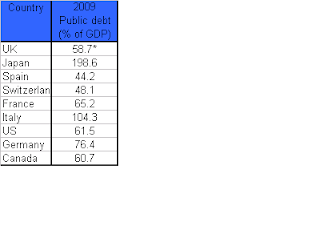
Source: IMF and * OECD
Bill Gross (Pimco) used a striking analogy for these countries, calling them “the ring of fire” and placed the respective countries in an illustrative matrix. (Exhibit3)
Exhibit 3 The Ring of Fire

Source: PIMCO, January 2010
This is not an unusual phenomenon. Rogoff and Reinhart analysed financial crises and the spill out effects since the inception of banking. In their paper they come to the conclusion that the aftermath of banking crises goes hand in hand with a sharp rise of domestic debt (between 50-100%), which consequently triggers a high inflation environment and ultimately ends in a series of defaults on outstanding sovereign debt and usually a currency crisis.
At this very moment Greece is already becoming a victim of this phenomenon. The spill over effects towards the rest of Southern European countries, the PIGS, is more than science fiction. Therefore all these countries are in the “Circle of Lucifer” as we would call it.
In the CDS market we have already seen a clear divergence since the beginning of last year, and lately the EUR has been under pressure due to the Greek turmoil. However a country that we miss in this Lucifer’s club is Belgium.
We do believe there is a very strong case to be made that the market is underestimating a similar risk for Belgium. At this moment the 5 year CDS spread of Belgium is only trading slightly above 60 bps. Compared with the PIGS countries this is negligible, as all of them are trading well above 100 bp and even higher.
Taking into account the macro economical and political situation of Belgium there is a strong case to be made to buy protection of Belgium sovereign risk. There are a few reasons to underwrite this argument:
• Weak Industry
The Belgian industry has been losing competitiveness over its direct trading partners over the last 8-10 years. The labour cost compared to their main trading partners Germany-Netherlands-France and UK is more than 10% higher which gives them a major competitive handicap.
Furthermore the Belgian industry has disappeared over time in the hands of foreign multinationals. The energy industry for example came into the hands of French conglomerate Suez, and makes Belgium among EU members one of the most energy dependent countries in Europe. As an important side note, Suez is paying 0% taxes on the Belgium synergies due to a tax loop. Due to this, the Belgian Treasury is missing hundreds of million of EUR’s in taxes.
This is an amount that would be very welcome, considering the state of Belgian public finances. Belgian government debt showed a similar trend like other sovereigns around the world, and is expected to rise above 100% of GDP again this year. In this respect Belgian government debt is catching up rapidly with the PIGS debt.
• Wrecked Banking Industry
In Western Europe, the Belgian banking industry was hit almost as hard as Ireland and Iceland. Fortis, Dexia and KBC were brought on the verge of bankruptcy and either had to be sold to foreign competitors (Fortis) or came under curatele from the Belgian government (Dexia) or received very expensive government loans (KBC).
Because of this, the three banks that played a major role for the local mid cap industry that is the driving economic engine of Belgium, remain very restrictive in their credit policy. As a consequence the economy is suffering considerably. In January alone an additional 20,000 jobs went lost, bringing the unemployment rate back above 8.2%, which is an average national level. The differences between North and South are even more flawed. In the South there are regions with over 17% of unemployment.
• Political instability
For over 2.5 years the country has been pulled into its deepest institutional crisis since its inception in 1831. The contradictions between the rich North and the poor South have become so obstructive that it is almost impossible to put a government in place which can run an effective economic policy. The cry for more autonomy is high in the North, Flanders, which destabilizes the country and feeds extremism.
Structural decisions that urgently must be taken in order to tackle the aging of the population and issues around public finances are postponed as there is no will at either side of the language frontier to take an initiative.
• Deteriorating legal environment
Over the last 4-5 years Belgian dropped on the official UN Corruption ladder a couple of notches and is now at the same level of Italy. The Justice Department is hopelessly underinvested and understaffed. It is no exception that law suits settle after more than 10 years. There are even several examples where certain legal disputes even expire their legal dead line which creates a legal vacuum for business.
Jail sentences of less than 3 years are not executed anymore because of a painful over population of prisons, for which Belgium has been condemned already on several occasions by the Court of Human Rights, which feeds a further feeling of anarchy.
Taking all these arguments into account, there is a good reason to expect that Belgians credit spread will start sliding off into the direction of the PIGS and soon becomes a member of the Circle of Lucifer.
We have written on several occasions about the credit bubble that triggered a considerable deleveraging wave in the private sector. However the world has not become a safer place. The debt build up among banks and consumers, in the period before the break out of the Great Credit Crisis 2007-2009, has transferred to the public sector.
Like in physics there is the law of communicating barrels. As one barrel full of water can be emptied with a tube whilst filling another barrel, so is the private sector trying to lower its outstanding debt level while increasing the leverage of the public sector.
Exhibit 1 shows that the total outstanding debt, taking every sector into account (corporates, financials, non-financials, households and governments), is still very worrisome in the developed markets despite a serious deleveraging process in the financial sector.
Exhibit 1 Total Debt as a % of GDP in 2008

Source: McKinsey January 2010
As we have seen during the latest deleveraging cycle, government debts are mounting. This is also described by H. Minsky. The problem is that certain countries before the break out of the crisis already showed bad public finance practices, which makes the current situation even more serious.
Japan, that has been fighting against deflation for more than a decade, the US and some southern EUR-zone countries are threatened by a sovereign debt crisis. (Exhibit 2)
Exhibit 2 Public debt as a % of GDP in 2009

Source: IMF and * OECD
Bill Gross (Pimco) used a striking analogy for these countries, calling them “the ring of fire” and placed the respective countries in an illustrative matrix. (Exhibit3)
Exhibit 3 The Ring of Fire

Source: PIMCO, January 2010
This is not an unusual phenomenon. Rogoff and Reinhart analysed financial crises and the spill out effects since the inception of banking. In their paper they come to the conclusion that the aftermath of banking crises goes hand in hand with a sharp rise of domestic debt (between 50-100%), which consequently triggers a high inflation environment and ultimately ends in a series of defaults on outstanding sovereign debt and usually a currency crisis.
At this very moment Greece is already becoming a victim of this phenomenon. The spill over effects towards the rest of Southern European countries, the PIGS, is more than science fiction. Therefore all these countries are in the “Circle of Lucifer” as we would call it.
In the CDS market we have already seen a clear divergence since the beginning of last year, and lately the EUR has been under pressure due to the Greek turmoil. However a country that we miss in this Lucifer’s club is Belgium.
We do believe there is a very strong case to be made that the market is underestimating a similar risk for Belgium. At this moment the 5 year CDS spread of Belgium is only trading slightly above 60 bps. Compared with the PIGS countries this is negligible, as all of them are trading well above 100 bp and even higher.
Taking into account the macro economical and political situation of Belgium there is a strong case to be made to buy protection of Belgium sovereign risk. There are a few reasons to underwrite this argument:
• Weak Industry
The Belgian industry has been losing competitiveness over its direct trading partners over the last 8-10 years. The labour cost compared to their main trading partners Germany-Netherlands-France and UK is more than 10% higher which gives them a major competitive handicap.
Furthermore the Belgian industry has disappeared over time in the hands of foreign multinationals. The energy industry for example came into the hands of French conglomerate Suez, and makes Belgium among EU members one of the most energy dependent countries in Europe. As an important side note, Suez is paying 0% taxes on the Belgium synergies due to a tax loop. Due to this, the Belgian Treasury is missing hundreds of million of EUR’s in taxes.
This is an amount that would be very welcome, considering the state of Belgian public finances. Belgian government debt showed a similar trend like other sovereigns around the world, and is expected to rise above 100% of GDP again this year. In this respect Belgian government debt is catching up rapidly with the PIGS debt.
• Wrecked Banking Industry
In Western Europe, the Belgian banking industry was hit almost as hard as Ireland and Iceland. Fortis, Dexia and KBC were brought on the verge of bankruptcy and either had to be sold to foreign competitors (Fortis) or came under curatele from the Belgian government (Dexia) or received very expensive government loans (KBC).
Because of this, the three banks that played a major role for the local mid cap industry that is the driving economic engine of Belgium, remain very restrictive in their credit policy. As a consequence the economy is suffering considerably. In January alone an additional 20,000 jobs went lost, bringing the unemployment rate back above 8.2%, which is an average national level. The differences between North and South are even more flawed. In the South there are regions with over 17% of unemployment.
• Political instability
For over 2.5 years the country has been pulled into its deepest institutional crisis since its inception in 1831. The contradictions between the rich North and the poor South have become so obstructive that it is almost impossible to put a government in place which can run an effective economic policy. The cry for more autonomy is high in the North, Flanders, which destabilizes the country and feeds extremism.
Structural decisions that urgently must be taken in order to tackle the aging of the population and issues around public finances are postponed as there is no will at either side of the language frontier to take an initiative.
• Deteriorating legal environment
Over the last 4-5 years Belgian dropped on the official UN Corruption ladder a couple of notches and is now at the same level of Italy. The Justice Department is hopelessly underinvested and understaffed. It is no exception that law suits settle after more than 10 years. There are even several examples where certain legal disputes even expire their legal dead line which creates a legal vacuum for business.
Jail sentences of less than 3 years are not executed anymore because of a painful over population of prisons, for which Belgium has been condemned already on several occasions by the Court of Human Rights, which feeds a further feeling of anarchy.
Taking all these arguments into account, there is a good reason to expect that Belgians credit spread will start sliding off into the direction of the PIGS and soon becomes a member of the Circle of Lucifer.
Friday, 22 January 2010
Greece... The next Atlantis?
The turmoil around Greece started two weeks ago when ECB board member Juergen Stark said that Greece should not expect the EU to bail it out if its public deficit becomes unbearable. Since then even ECB President Jean Claude Trichet echoed similar comments on the public finances of Greece.
At the moment Greece is looking for a way out, either autonomously, or through help via the IMF. So far plans worked out by the Greece government to reduce the fiscal deficit from -12% back below the Maastricht level of - 3% by 2013, are received negatively.
This scepticism has to do with the fact that Eurostat, the statistical data centre of the European Commission (EC), found out that Greece has been manipulating the budget data towards the EC between 2005 and 2009. In this respect chances of reducing the budget deficit on its own strength are less credible.
This makes the exit via IMF advisors more likely. IMF officials arrived in Athens last week and are looking at the situation. Previous emerging market crises teach us that such kind of visits often precede a full IMF assistance programme. In the current environment, we think the announcement of such a programme would force Greek spreads significantly lower, even if the amounts being offered by the IMF are relatively small.
For the ECB and EC the IMF solution would be a clean one as well. It would be a strong signal towards other member states such as Spain, Portugal, Italy and Belgium to get their finances back under control. If not they would risk the loss of sovereign control over their finances towards the IMF. A non-intervention by the ECB and/or EC would avoid a moral hazard as we know it in the banking system.
If the ECB and/or EC would act as lender of last resort, it would be a signal towards countries such as Spain etc. to loosen their fiscal discipline as they would be bailed out somewhere in the future anyway.
We believe that the chances of a EUR break up are very small. For both the strong EUR-zone members as for the vulnerable ones such as Greece this would be a lose-lose situation. For the stronger members it would raise the risk of contagion towards other member states, and this would put significant pressure on the EUR.
In such a scenario a drop of the EUR of 20-30%, which is a similar drop if one compares this with other FX EM crises, would not be unrealistic. This is the type of volatility that EUR members want to avoid by any means. It would give them temporarily an export advantage over the US, but the credit spreads for the EUR members to issue sovereign credit would widen substantially as well.
Exiting the EUR for a country like Greece would be even more disastrous. The country would undergo an extreme devaluation of its new Greek Drachme. This would then give short term benefits from an export perspective. This is a technique Italy applied on various occasions during the 1980s. However Greece has less revenue coming from export activities compared to Italy. It would though have a small revival impact on export and growth, which would temporarily diminish the debt issues and raise employment, all this via tax revenues.
However, they would very quickly be faced with a spiralling of wage inflation and domestic prices as well. This is the phenomenon that we have seen in countries like Argentina at the beginning of this decade.
All this makes an IMF solution more probable. As a consequence credit spreads would come in slightly, but we will keep on seeing a substantial divergence of spreads between Greece and the core countries of the EUR-zone.
At the moment Greece is looking for a way out, either autonomously, or through help via the IMF. So far plans worked out by the Greece government to reduce the fiscal deficit from -12% back below the Maastricht level of - 3% by 2013, are received negatively.
This scepticism has to do with the fact that Eurostat, the statistical data centre of the European Commission (EC), found out that Greece has been manipulating the budget data towards the EC between 2005 and 2009. In this respect chances of reducing the budget deficit on its own strength are less credible.
This makes the exit via IMF advisors more likely. IMF officials arrived in Athens last week and are looking at the situation. Previous emerging market crises teach us that such kind of visits often precede a full IMF assistance programme. In the current environment, we think the announcement of such a programme would force Greek spreads significantly lower, even if the amounts being offered by the IMF are relatively small.
For the ECB and EC the IMF solution would be a clean one as well. It would be a strong signal towards other member states such as Spain, Portugal, Italy and Belgium to get their finances back under control. If not they would risk the loss of sovereign control over their finances towards the IMF. A non-intervention by the ECB and/or EC would avoid a moral hazard as we know it in the banking system.
If the ECB and/or EC would act as lender of last resort, it would be a signal towards countries such as Spain etc. to loosen their fiscal discipline as they would be bailed out somewhere in the future anyway.
We believe that the chances of a EUR break up are very small. For both the strong EUR-zone members as for the vulnerable ones such as Greece this would be a lose-lose situation. For the stronger members it would raise the risk of contagion towards other member states, and this would put significant pressure on the EUR.
In such a scenario a drop of the EUR of 20-30%, which is a similar drop if one compares this with other FX EM crises, would not be unrealistic. This is the type of volatility that EUR members want to avoid by any means. It would give them temporarily an export advantage over the US, but the credit spreads for the EUR members to issue sovereign credit would widen substantially as well.
Exiting the EUR for a country like Greece would be even more disastrous. The country would undergo an extreme devaluation of its new Greek Drachme. This would then give short term benefits from an export perspective. This is a technique Italy applied on various occasions during the 1980s. However Greece has less revenue coming from export activities compared to Italy. It would though have a small revival impact on export and growth, which would temporarily diminish the debt issues and raise employment, all this via tax revenues.
However, they would very quickly be faced with a spiralling of wage inflation and domestic prices as well. This is the phenomenon that we have seen in countries like Argentina at the beginning of this decade.
All this makes an IMF solution more probable. As a consequence credit spreads would come in slightly, but we will keep on seeing a substantial divergence of spreads between Greece and the core countries of the EUR-zone.
Monday, 11 January 2010
Bernanke playing Pontius Pillatus
Dear readers,
Fed Chairman Ben Bernanke made surprising comments during a speech at the annual meeting of the American Economic Association. He argued that the link between the aggressive monetary policy after the burst of the dotcom bubble and the 9/11 events on the one hand, and the rise of real estate prices on the other was weak to non existent.
In other words he is denying that the zero-rate policy from his predecessor, Alan Greenspan, was not the driving force behind the build up of the US real estate asset bubble. To support his thesis, he argues that there were a number of countries that had tighter monetary restrictions but still faced an even greater housing bubble compared to the US.
He continued by saying that the use of Adjustable Rate Mortgages (ARM’s) and the lack of regulation prohibiting the sale of these products that was more to blame for blowing up a housing bubble.
There are three major arguments to counter Mr. Ben Bernanke’s thesis:
• Taylor Rule
• Euro zone project
• Financial innovation versus regulation
A. The Taylor Rule
Lat year we already wrote about the Taylor rule. In the early 1970s professor John Taylor developed a model that could determine the appropriate level for (nominal) interest rates based upon the difference between real GDP and potential GDP, often called the GDP GAP.
Apart from the issues that we raised regarding the application of the Taylor rule in the current economic environment, the rule is up to a certain level a reliable tool for central banks to analyse their monetary policy.
Although a proactive/forward looking central bank will concentrate on a variety of macro economic leading indicators instead of examining the realized or expected inflation gap. Nevertheless as a back testing tool the Taylor rule gives reliable results on appropriateness of monetary policies.
Applying this over the period 2002-2005, the Taylor rule shows that the Fed’s monetary policy was too aggressive. Figure 1 shows where Fed fund rates should have been corresponding with 0,1,2,3 or 4% of inflation. Over the period Jan 2002 – Jan 2005 the average US inflation rate was 2.18%. As the chart indicates, Fed fund rates were well below the level what the Taylor rule teaches us (calculations are based upon analysis from the Fed of St. Louis).
Figure 1 Federal Fund Rates based on Taylor’s rule

Source: Federal Reserve of St. Louis
The chart also confirms the fundamental problem that central banks are coping with, i.e. the mismatch in timing of monetary policy versus economic growth. If one compares the change in federal fund rates with the average growth rate in GDP terms during the previous two years one gets a clear view of the overshooting of monetary policy of the Fed (Figure 2).
Figure 2: US 2 Year Nominal GDP Growth versus Fed Fund Rates 1960 – 2008 (1)

Source: Bloomberg Data
Figure 2 also illustrates that the Fed, but this can be generalised to any other central bank, is only catching up periods of economic recovery, but due to its slow response it is paving the way of a next crisis. In other words interventions by central banks can are akin to a pendulum swinging from one extreme to another.
The major reason forl this is because central banks focus not enough on asset price developments. Not only the Fed failed stumbled over this over the years. Another good example is the Bank of Japan that failed to acknowledge the build up of an asset bubble in its economy as well during the late eighties. This triggered the Lost Decade of Japan with deflation continually hampering a sustained economic recovery.
This is a first argument against Chairman Ben Bernanke’s effort in downplaying the role of the Federal Reserve in the US housing crisis.
B. Euro zone project
Then, there is the argument from the Fed Chairman that there were also countries that had tighter monetary restrictions but still faced an even greater housing bubble compared to the US.
It is true that in Spain and/or Ireland, two countries that suffered greatly in the housing crash, interest rates were higher than in the US. However one should not forget that these countries are part of a monetary (EUR) zone where interest rates are set for the whole region. Especially countries like Spain and Ireland were struggling right from the start with an overheating economy, as interest rates set by the ECB were far too low for their domestic economies.
This was inherent in the EUR project where the ECB had to apply a “one size fits all” monetary policy. Nevertheless it is highly unlikely that an independent central bank of Ireland would have kept interest rates that low. Bear in mind that during 2000 Irish inflation ran up to almost 7%. A lose monetary policy (for Ireland) set by the ECB led to cheap Irish credit and consequentially to a real estate bubble. A similar phenomenon was observed in Spain.
This weakens Mr. Bernanke’s thesis further.
C. Financial innovation versus regulation
Last but not least ARM’s and other inventive mortgage products are blamed for the housing bubble. It would be more correct to argue that these products contributed in part to the inflation of house prices, nevertheless the source of the problem remained too much money chasing too few goods.
Hyman Minsky already described the phenomenon of increased financial innovation and deregulation at the end of a business cycle. ARM’s and other products were simply a sign of the times. Even without these products the housing bubble would have been continuously fed via more conventional mortgage products. If money is available for free and on top of that there is the dogmatic conviction amongst house buyers that prices will only ever go up, the end result is a drop in lending standards and asset price inflation.
It is naïve to believe that regulators could have prevented the negative fall out of excess cheap credit by restricting exotic financial instruments. It is like using garden tools in the kitchen. Furthermore regulatory bodies can not regulate as fast as financial institutions innovate. Also, one should not forget that financial institutions are more pushed towards financial innovation (in creating cheap money) when rates are high. That was not the case when banks started to introduce these ARM’s. Rates were very close to zero at the time they were introduced.
In this respect the arguments Mr. Bernanke is raising in playing down the role of the Fed in the build up of this crisis are weak. Certainly there were perhaps 10.12 different key factors, all interacting together over a period of time, that created the crash. For example the role of the US government should not be forgotten. Indirectly via its government sponsored enterprises (GSE’s), Fannie Mae and Freddie Mac, it supported the mortgage-backed securities market and encouraged risk taking.
Nevertheless central banks carry a huge responsibility and as long as they will not start paying attention to asset price developments they risk staying behind the curve and fueling the flames of the next crisis.
(1) Also see Brian S Wesburry “ A US Addiction to Easy Money “, Oct 1994 Journal of Commerce and Gerald O’ Driscoll Jr. ”Asset Bubbles and their Consequences”, May 2008, Cato Institute
Fed Chairman Ben Bernanke made surprising comments during a speech at the annual meeting of the American Economic Association. He argued that the link between the aggressive monetary policy after the burst of the dotcom bubble and the 9/11 events on the one hand, and the rise of real estate prices on the other was weak to non existent.
In other words he is denying that the zero-rate policy from his predecessor, Alan Greenspan, was not the driving force behind the build up of the US real estate asset bubble. To support his thesis, he argues that there were a number of countries that had tighter monetary restrictions but still faced an even greater housing bubble compared to the US.
He continued by saying that the use of Adjustable Rate Mortgages (ARM’s) and the lack of regulation prohibiting the sale of these products that was more to blame for blowing up a housing bubble.
There are three major arguments to counter Mr. Ben Bernanke’s thesis:
• Taylor Rule
• Euro zone project
• Financial innovation versus regulation
A. The Taylor Rule
Lat year we already wrote about the Taylor rule. In the early 1970s professor John Taylor developed a model that could determine the appropriate level for (nominal) interest rates based upon the difference between real GDP and potential GDP, often called the GDP GAP.
Apart from the issues that we raised regarding the application of the Taylor rule in the current economic environment, the rule is up to a certain level a reliable tool for central banks to analyse their monetary policy.
Although a proactive/forward looking central bank will concentrate on a variety of macro economic leading indicators instead of examining the realized or expected inflation gap. Nevertheless as a back testing tool the Taylor rule gives reliable results on appropriateness of monetary policies.
Applying this over the period 2002-2005, the Taylor rule shows that the Fed’s monetary policy was too aggressive. Figure 1 shows where Fed fund rates should have been corresponding with 0,1,2,3 or 4% of inflation. Over the period Jan 2002 – Jan 2005 the average US inflation rate was 2.18%. As the chart indicates, Fed fund rates were well below the level what the Taylor rule teaches us (calculations are based upon analysis from the Fed of St. Louis).
Figure 1 Federal Fund Rates based on Taylor’s rule

Source: Federal Reserve of St. Louis
The chart also confirms the fundamental problem that central banks are coping with, i.e. the mismatch in timing of monetary policy versus economic growth. If one compares the change in federal fund rates with the average growth rate in GDP terms during the previous two years one gets a clear view of the overshooting of monetary policy of the Fed (Figure 2).
Figure 2: US 2 Year Nominal GDP Growth versus Fed Fund Rates 1960 – 2008 (1)

Source: Bloomberg Data
Figure 2 also illustrates that the Fed, but this can be generalised to any other central bank, is only catching up periods of economic recovery, but due to its slow response it is paving the way of a next crisis. In other words interventions by central banks can are akin to a pendulum swinging from one extreme to another.
The major reason forl this is because central banks focus not enough on asset price developments. Not only the Fed failed stumbled over this over the years. Another good example is the Bank of Japan that failed to acknowledge the build up of an asset bubble in its economy as well during the late eighties. This triggered the Lost Decade of Japan with deflation continually hampering a sustained economic recovery.
This is a first argument against Chairman Ben Bernanke’s effort in downplaying the role of the Federal Reserve in the US housing crisis.
B. Euro zone project
Then, there is the argument from the Fed Chairman that there were also countries that had tighter monetary restrictions but still faced an even greater housing bubble compared to the US.
It is true that in Spain and/or Ireland, two countries that suffered greatly in the housing crash, interest rates were higher than in the US. However one should not forget that these countries are part of a monetary (EUR) zone where interest rates are set for the whole region. Especially countries like Spain and Ireland were struggling right from the start with an overheating economy, as interest rates set by the ECB were far too low for their domestic economies.
This was inherent in the EUR project where the ECB had to apply a “one size fits all” monetary policy. Nevertheless it is highly unlikely that an independent central bank of Ireland would have kept interest rates that low. Bear in mind that during 2000 Irish inflation ran up to almost 7%. A lose monetary policy (for Ireland) set by the ECB led to cheap Irish credit and consequentially to a real estate bubble. A similar phenomenon was observed in Spain.
This weakens Mr. Bernanke’s thesis further.
C. Financial innovation versus regulation
Last but not least ARM’s and other inventive mortgage products are blamed for the housing bubble. It would be more correct to argue that these products contributed in part to the inflation of house prices, nevertheless the source of the problem remained too much money chasing too few goods.
Hyman Minsky already described the phenomenon of increased financial innovation and deregulation at the end of a business cycle. ARM’s and other products were simply a sign of the times. Even without these products the housing bubble would have been continuously fed via more conventional mortgage products. If money is available for free and on top of that there is the dogmatic conviction amongst house buyers that prices will only ever go up, the end result is a drop in lending standards and asset price inflation.
It is naïve to believe that regulators could have prevented the negative fall out of excess cheap credit by restricting exotic financial instruments. It is like using garden tools in the kitchen. Furthermore regulatory bodies can not regulate as fast as financial institutions innovate. Also, one should not forget that financial institutions are more pushed towards financial innovation (in creating cheap money) when rates are high. That was not the case when banks started to introduce these ARM’s. Rates were very close to zero at the time they were introduced.
In this respect the arguments Mr. Bernanke is raising in playing down the role of the Fed in the build up of this crisis are weak. Certainly there were perhaps 10.12 different key factors, all interacting together over a period of time, that created the crash. For example the role of the US government should not be forgotten. Indirectly via its government sponsored enterprises (GSE’s), Fannie Mae and Freddie Mac, it supported the mortgage-backed securities market and encouraged risk taking.
Nevertheless central banks carry a huge responsibility and as long as they will not start paying attention to asset price developments they risk staying behind the curve and fueling the flames of the next crisis.
(1) Also see Brian S Wesburry “ A US Addiction to Easy Money “, Oct 1994 Journal of Commerce and Gerald O’ Driscoll Jr. ”Asset Bubbles and their Consequences”, May 2008, Cato Institute
Friday, 4 December 2009
2010 outlook
Dear readers,
We are in the last straight line of what has been a challenging 2009 for every one of us and not only those who have a job in finance. It was an emotional roller coaster where the world crawled through the symbolic eye of the needle in avoiding a depression we only saw back in the 1930s. After that we saw equity markets euphorically rebound from their lows in mid March under the umbrella of massive government worldwide.
Green shoots were added to our vocabulary but we can not shrug off the impression there is a divergence going on between the health of the economy and the state of the stock market. The world is clearly looking for a new equilibrium, and it is obvious it will be at a (much) lower level than we have known earlier this decade.
We admit we underestimated the rebound of the stock market, but we should have known if we had considered the trillions of dollars of liquidity that were poured into the market by governments to keep the financial system afloat. So far our mea culpa of 2009.
Nevertheless we persist in seeing very dark clouds above us. While the stock market is taking a massive advance on economic recovery, the bond market is telling us a completely different story. Yields on short term fixed income paper have been pushed down to almost zero (US T-Bills maturing April 2010 are yielding hardly 7 bps) which forces investors to chase more risky assets or, as Bill Gross of Pimco argued recently “The process of reflation involves lowering short-term rates to such a painful level that investors are forced or enticed to term out their short-term cash into higher-risk bonds or stocks.”
However this almost negative yield level is also indicating that some investors prefer to pay the government to hold their cash in stead of putting their money at work.
It remains the one million dollar question when the Fed and other central banks are going to take back all this liquidity. Maybe from mid 2010 onwards, but it can be (much) later as well. One thing we know already, this will be a painful process for investors. We live at this moment in a very confused environment. On the one hand it is the best of times for investors as central banks offer a “free lunch” to the market, but on the other hand we face the worst of times as the economic fundamentals are still impaired.
One of the major economic challenges will be what will happen in the commercial real estate market. There are some similarities with the residential – subprime market which triggered the Great Credit Crisis of 2007. Back then prices of subprime mortgage bonds, reflected in the ABX Index, were already falling systematically since July 2006. Things deteriorated dramatically over that year and early 2007, HSBC and New Century, two of the major US lenders in that market, gave a first hint they had to make considerable provisions on their mortgage portfolio. It was only at the beginning of August, when two money market funds of BNP Paribas got into trouble, that the distress of the real estate market caught the eye of the public.
Of course, since the beginning of the crisis commercial real estate has been hit hard as well, however there are signs that things are deteriorating. Even the Federal Reserve admits this in its recent Beige Book report.
In the US, year to date there were already 5,772 foreclosures, defaults or bankruptcies representing an amount of $ 123 billion (data: Real Capital Analytics). The major reason is because commercial real estate was highly leveraged, and as a lot of these loans need to be re-financed, the industry is suffering as banks stand on the brakes to continue lending.
To underwrite the statement of Carolyn Maloney, Chairwoman of the Congressional Joint Economic Committee, saying that the commercial real estate market is a ticking time bomb: in the US alone, over $ 2.7 trillion of commercial real estate debt will have to be rolled over in the next 5 years with a peak in 2012 (these numbers do not take into account the additional $ 700 billion – $1.1 trillion of speculative leveraged finance debt). For 2010 between $ 530 and $ 700 billion is due for refinancing (data: Foresight Analytics LLC). According to the FDIC this can bring a total of 700 banks at risk of failure. A disproportionately high number of small and medium-sized banks have sizeable exposure to commercial real estate loans, and delinquency rates at around 7 percent will add further pressure on banks balance sheets that must mark these loans to market.
Financial institutions around the globe are very aware of this next tsunami wave and this is one of the major reasons why banks are so reluctant to lend. The facilities being put in place by central banks are primarily used to restore banks’s balance sheets so as to be robust enough to take the next commercial real estate hit. Lending is only of secondary concern.
Another worrying sign of the commercial real estate situation was the Fed intervention to throw out five commercial market bonds that were pledged as collateral for taxpayer loans to purchase debt earlier in November.
In an effort to clean up bank balance sheets and encourage new lending, the Fed opened its Term Asset-Backed Securities Loan Facility (TALF) to so-called legacy commercial-mortgage bonds. TALF attracts buyers by pumping up returns with low-cost Fed loans. Bonds deemed too risky are rejected. But the latter will limit future appetite for the programme.
All this will continue to weigh as a sword of Damocles on the market in 2010. Will it trigger a huge correction? Maybe, but not necessarily. This is in the hands of the central banks. Only as from the moment they indicate rates will rise again, markets will get nervous.
An interesting report published by the Investment Company Institute, the national association of US investment companies overlooking over $ 11 trillion of assets under management, is showing that cash which was parked on the sideline since the Lehman collapse back in September last year is steadily flowing back to the equity market. Nevertheless the amount that is parked on deposit accounts and money market funds is still well above historical levels.
This teaches us that the stock market remains well supported as any major correction will be used to put money at work. Not because the economic outlook is prosperous, but fund managers are judged by benchmark performances and many of them have missed the rally which took off mid March.
Furthermore the data of the ICI shows especially institutional investors have missed out on the rally, confirming our previous reports that this was a retail driven rally.
This means there is a reasonable possibility that the rally will continue into early 2010, as institutional investors can not afford to remain sidelined.
In the meantime, most probably, we will get further mixed economic data, confirming what John Mauldin still calls a muddle through economy as banks, corporates and consumers continue their deleveraging process.
Around April, when Q1 results come in, it will be a first moment of truth to see whether the preliminary recovery that we have experienced so far is only built upon stockpile adjustments or whether the US consumer shows more resilience. Although considering the fact that Average Joe still needs to bring down its debt ratios and increase it savings it is unlikely that it will come from that side. Therefore any further growth prospects should come from China that continues its path of economic development, on further governmental support.
This brings us to another potential dark cloud, the US government debt. During 2009 the US Treasury had to finance approximately $ 1.8 trillion of debt as a consequence of several bailout packages. For the fiscal year 2010 the White House projects a deficit of roughly $ 1.26 trillion. This is under the assumption that no further bailouts or stimulus packages are needed during next year. Also bear in mind there is another $ 1 trillion to be digested by the bond market for fiscal year 2011 ceteris paribus. (These numbers do not even take into account the additional burden on the US budget due to the new healthcare plans which were approved in Congress earlier this month).This is certainly an environment where the US Treasury can not afford any failed auctions on its bond issuances. Together with a USD which remains under pressure it will be interesting to see how US sovereign debt credit spreads will behave.
There will be no problems at all as long as sovereign wealth funds and other foreign banks continue to buy up US government debt. However from the moment the bond market starts sputtering spreads will widen again. Consider this as a potential black swan event hanging over the market for the next few years with a probability that the market priced at a too low a level the actual risk. This will certainly be a trade where event driven and/or global macro hedge fund managers will continue to look at.
It’s a small step from the US government debt to the USD. Due to the monetary outlook from the Fed, the USD is now used as a borrowing currency in the carry trade, similar to what happened to the JPY over the last 15 years.
We are still waiting for data from the Bank of International Settlements (BIS) to get an idea what the size is of this USD carry trade. Mr. Roubinni earlier this week argued it is 10 times the size of the JPY carry trade. To put this into perspective, according to data from the BIS the total amount of the JPY carry trade was around $ 1.05 trillion!!!
A change in the outlook of US monetary policy will trigger immense volatility in the currency market. In case this happens the borrowed currency starts rising rapidly as every investor involved in the trade has to start buying this currency in order to pay back the loan.
There are several examples of that over the last several years. One to remember was the unwind of the JPY carry trade in September 1999 when the hedge fund LTCM collapsed. In less than a month USDJPY dropped from 122 to almost 100.
Therefore we remain very cautious on recent USD weakness. This can be reverted in a split second, and we consider this one of the major risks of 2010. Even when the current USD carry trade is only twice the amount of the JPY position in 2007, there is a massive systemic risk hanging above the market which can easily push EURUSD towards 1.20 again in a number of weeks. The longer term outlook on the USD however remains very concerning due to the US deficit.
Last but not least the financial state of banks. On both sides of the Atlantic some banks still are in deep trouble but can mask their situation at this moment by a combination of creative accounting and the benefits of a steep yield curve. The head of the IMF, Dominique Stauss-Kahn, expressed similar concerns, arguing that there is a reasonable possibility that 50% of bank losses have not been reported yet, and are hidden in the balance sheets especially among European banks. Only last week the market got shaken up by woes in the Middle East where Dubai World was unable to roll over its debt. Especially major European banks have exposure of up to USD 20 billion to the Emirates state. This is certainly not helpful to the already fragile balance sheets of the financial industry.
If this is a fact 1 of 2 developments could be seen in 2010. Either we might see another wave of nationalisations or, depending on the risk aversion of the markets, banks will have to raise more capital individually. The latter is more likely if we do not return into a Minsky moment like we have seen when AIG and Lehman collapsed during the same week.
To round up cryptically, 2010 will remain a very difficult year, where the cheap funding from central banks act as the Lorelei, one of the Rhine Maidens of the famous Nibelungen song, who rises from the waters trying to lure the ships onto the cliffs with her seductive singing. Despite these temptations it would be wise to keep your ships close to the coast in these stormy weathers.
We are in the last straight line of what has been a challenging 2009 for every one of us and not only those who have a job in finance. It was an emotional roller coaster where the world crawled through the symbolic eye of the needle in avoiding a depression we only saw back in the 1930s. After that we saw equity markets euphorically rebound from their lows in mid March under the umbrella of massive government worldwide.
Green shoots were added to our vocabulary but we can not shrug off the impression there is a divergence going on between the health of the economy and the state of the stock market. The world is clearly looking for a new equilibrium, and it is obvious it will be at a (much) lower level than we have known earlier this decade.
We admit we underestimated the rebound of the stock market, but we should have known if we had considered the trillions of dollars of liquidity that were poured into the market by governments to keep the financial system afloat. So far our mea culpa of 2009.
Nevertheless we persist in seeing very dark clouds above us. While the stock market is taking a massive advance on economic recovery, the bond market is telling us a completely different story. Yields on short term fixed income paper have been pushed down to almost zero (US T-Bills maturing April 2010 are yielding hardly 7 bps) which forces investors to chase more risky assets or, as Bill Gross of Pimco argued recently “The process of reflation involves lowering short-term rates to such a painful level that investors are forced or enticed to term out their short-term cash into higher-risk bonds or stocks.”
However this almost negative yield level is also indicating that some investors prefer to pay the government to hold their cash in stead of putting their money at work.
It remains the one million dollar question when the Fed and other central banks are going to take back all this liquidity. Maybe from mid 2010 onwards, but it can be (much) later as well. One thing we know already, this will be a painful process for investors. We live at this moment in a very confused environment. On the one hand it is the best of times for investors as central banks offer a “free lunch” to the market, but on the other hand we face the worst of times as the economic fundamentals are still impaired.
One of the major economic challenges will be what will happen in the commercial real estate market. There are some similarities with the residential – subprime market which triggered the Great Credit Crisis of 2007. Back then prices of subprime mortgage bonds, reflected in the ABX Index, were already falling systematically since July 2006. Things deteriorated dramatically over that year and early 2007, HSBC and New Century, two of the major US lenders in that market, gave a first hint they had to make considerable provisions on their mortgage portfolio. It was only at the beginning of August, when two money market funds of BNP Paribas got into trouble, that the distress of the real estate market caught the eye of the public.
Of course, since the beginning of the crisis commercial real estate has been hit hard as well, however there are signs that things are deteriorating. Even the Federal Reserve admits this in its recent Beige Book report.
In the US, year to date there were already 5,772 foreclosures, defaults or bankruptcies representing an amount of $ 123 billion (data: Real Capital Analytics). The major reason is because commercial real estate was highly leveraged, and as a lot of these loans need to be re-financed, the industry is suffering as banks stand on the brakes to continue lending.
To underwrite the statement of Carolyn Maloney, Chairwoman of the Congressional Joint Economic Committee, saying that the commercial real estate market is a ticking time bomb: in the US alone, over $ 2.7 trillion of commercial real estate debt will have to be rolled over in the next 5 years with a peak in 2012 (these numbers do not take into account the additional $ 700 billion – $1.1 trillion of speculative leveraged finance debt). For 2010 between $ 530 and $ 700 billion is due for refinancing (data: Foresight Analytics LLC). According to the FDIC this can bring a total of 700 banks at risk of failure. A disproportionately high number of small and medium-sized banks have sizeable exposure to commercial real estate loans, and delinquency rates at around 7 percent will add further pressure on banks balance sheets that must mark these loans to market.
Financial institutions around the globe are very aware of this next tsunami wave and this is one of the major reasons why banks are so reluctant to lend. The facilities being put in place by central banks are primarily used to restore banks’s balance sheets so as to be robust enough to take the next commercial real estate hit. Lending is only of secondary concern.
Another worrying sign of the commercial real estate situation was the Fed intervention to throw out five commercial market bonds that were pledged as collateral for taxpayer loans to purchase debt earlier in November.
In an effort to clean up bank balance sheets and encourage new lending, the Fed opened its Term Asset-Backed Securities Loan Facility (TALF) to so-called legacy commercial-mortgage bonds. TALF attracts buyers by pumping up returns with low-cost Fed loans. Bonds deemed too risky are rejected. But the latter will limit future appetite for the programme.
All this will continue to weigh as a sword of Damocles on the market in 2010. Will it trigger a huge correction? Maybe, but not necessarily. This is in the hands of the central banks. Only as from the moment they indicate rates will rise again, markets will get nervous.
An interesting report published by the Investment Company Institute, the national association of US investment companies overlooking over $ 11 trillion of assets under management, is showing that cash which was parked on the sideline since the Lehman collapse back in September last year is steadily flowing back to the equity market. Nevertheless the amount that is parked on deposit accounts and money market funds is still well above historical levels.
This teaches us that the stock market remains well supported as any major correction will be used to put money at work. Not because the economic outlook is prosperous, but fund managers are judged by benchmark performances and many of them have missed the rally which took off mid March.
Furthermore the data of the ICI shows especially institutional investors have missed out on the rally, confirming our previous reports that this was a retail driven rally.
This means there is a reasonable possibility that the rally will continue into early 2010, as institutional investors can not afford to remain sidelined.
In the meantime, most probably, we will get further mixed economic data, confirming what John Mauldin still calls a muddle through economy as banks, corporates and consumers continue their deleveraging process.
Around April, when Q1 results come in, it will be a first moment of truth to see whether the preliminary recovery that we have experienced so far is only built upon stockpile adjustments or whether the US consumer shows more resilience. Although considering the fact that Average Joe still needs to bring down its debt ratios and increase it savings it is unlikely that it will come from that side. Therefore any further growth prospects should come from China that continues its path of economic development, on further governmental support.
This brings us to another potential dark cloud, the US government debt. During 2009 the US Treasury had to finance approximately $ 1.8 trillion of debt as a consequence of several bailout packages. For the fiscal year 2010 the White House projects a deficit of roughly $ 1.26 trillion. This is under the assumption that no further bailouts or stimulus packages are needed during next year. Also bear in mind there is another $ 1 trillion to be digested by the bond market for fiscal year 2011 ceteris paribus. (These numbers do not even take into account the additional burden on the US budget due to the new healthcare plans which were approved in Congress earlier this month).This is certainly an environment where the US Treasury can not afford any failed auctions on its bond issuances. Together with a USD which remains under pressure it will be interesting to see how US sovereign debt credit spreads will behave.
There will be no problems at all as long as sovereign wealth funds and other foreign banks continue to buy up US government debt. However from the moment the bond market starts sputtering spreads will widen again. Consider this as a potential black swan event hanging over the market for the next few years with a probability that the market priced at a too low a level the actual risk. This will certainly be a trade where event driven and/or global macro hedge fund managers will continue to look at.
It’s a small step from the US government debt to the USD. Due to the monetary outlook from the Fed, the USD is now used as a borrowing currency in the carry trade, similar to what happened to the JPY over the last 15 years.
We are still waiting for data from the Bank of International Settlements (BIS) to get an idea what the size is of this USD carry trade. Mr. Roubinni earlier this week argued it is 10 times the size of the JPY carry trade. To put this into perspective, according to data from the BIS the total amount of the JPY carry trade was around $ 1.05 trillion!!!
A change in the outlook of US monetary policy will trigger immense volatility in the currency market. In case this happens the borrowed currency starts rising rapidly as every investor involved in the trade has to start buying this currency in order to pay back the loan.
There are several examples of that over the last several years. One to remember was the unwind of the JPY carry trade in September 1999 when the hedge fund LTCM collapsed. In less than a month USDJPY dropped from 122 to almost 100.
Therefore we remain very cautious on recent USD weakness. This can be reverted in a split second, and we consider this one of the major risks of 2010. Even when the current USD carry trade is only twice the amount of the JPY position in 2007, there is a massive systemic risk hanging above the market which can easily push EURUSD towards 1.20 again in a number of weeks. The longer term outlook on the USD however remains very concerning due to the US deficit.
Last but not least the financial state of banks. On both sides of the Atlantic some banks still are in deep trouble but can mask their situation at this moment by a combination of creative accounting and the benefits of a steep yield curve. The head of the IMF, Dominique Stauss-Kahn, expressed similar concerns, arguing that there is a reasonable possibility that 50% of bank losses have not been reported yet, and are hidden in the balance sheets especially among European banks. Only last week the market got shaken up by woes in the Middle East where Dubai World was unable to roll over its debt. Especially major European banks have exposure of up to USD 20 billion to the Emirates state. This is certainly not helpful to the already fragile balance sheets of the financial industry.
If this is a fact 1 of 2 developments could be seen in 2010. Either we might see another wave of nationalisations or, depending on the risk aversion of the markets, banks will have to raise more capital individually. The latter is more likely if we do not return into a Minsky moment like we have seen when AIG and Lehman collapsed during the same week.
To round up cryptically, 2010 will remain a very difficult year, where the cheap funding from central banks act as the Lorelei, one of the Rhine Maidens of the famous Nibelungen song, who rises from the waters trying to lure the ships onto the cliffs with her seductive singing. Despite these temptations it would be wise to keep your ships close to the coast in these stormy weathers.
Subscribe to:
Posts (Atom)
